Welcome to my Blog. I write primarily about bluegrass music and the bluegrass experience. I also review books I read as well as offering road notes and travel entries. Come in and look around to see whether there's anything here for you. Be sure to check the archives and the labels. Please leave comments. I try to respond to all of them.
About Me
Ted Lehmann
New Hampshire, United States
I am a retired English teacher/college professor who has a number of interests and enthusiasms, as suggested by the title of my blog. I have been married for 45 years to Irene and we have two adult children and four grandchildren. We love to travel, listen to and play bluegrass music, read, camp in our 21 foot travel trailer, watch television, argue about politics, and enjoy growing older together. All these enthusiasms and more find their way into this blog.
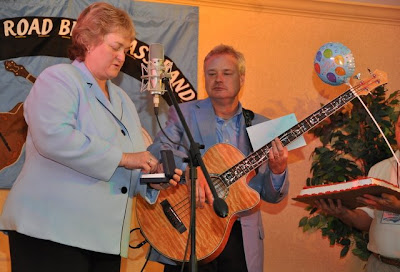
In many ways the Carolina Road Homecoming Bluegrass Festival functions as a family reunion as much as it does a musical event. Promoter Lorraine Jordan brings together a pretty large number of local and regional bluegrass bands for what functions as a showcase for the many promoters from the region who show up for this event. Lorraine’s loyalty to her many friends can be seen in the bands she invites, the active participation of her fan club as volunteers, the social climate of the festival, and the generally high quality of the music. Both today’s and tomorrow’s reports will include more pictures than words, but if festival means having a great time (festive) with old and new friends while engaging in a pastime enjoyed by all who decided to attend, then we had a festival. As the weekend wore on, perhaps more people could be found in the hallways and meeting rooms than in the audience at times, but they were sharing together in the fellowship of a bluegrass community coming off a winter of relative quiet and moving into a spring and summer of making and hearing fine music together. Who could ask for more?
Chris Jobe & Jordan
Chris Jobe
Jordan Young
Miz Bertie Sullivan & Lorraine
Bertie Sullivan is the promoter of a small and fabled festival held in Leaksville, Mississippi. She was a lively presence at the Homecoming, as well as the host of the Band Family Feud. A close eye kept on her small table at the rear of the performance area revealed her importance here through the number of people who took time to sit and chat with her.
Tami Butler (Mrs. Jerry) & Irene Lehmann
Shiela Talbert (Fan Extrodinaire)
Nixon, Blevins & Gage with Bill McDonald
The Larry Gillis Band
Evan Rose & Alex Leach
Larry playing claw hammer banjo
Emcee Sweet Brenda Lawson & Frances Mooney Clog to Larry's Claw Hammer
Ben Greene - Carolina Road banjo
Frances Mooney & Fontana Sunset
Frances Mooney
Mark Mundy
The pleasure of hearing Frances Mooney sing is increased because it is so clearly her own unique and strong voice. There's no effort to look or sound like Rhonda Vincent or Alison Kraus here, just the real thing right out of Georgia. After more than forty years playing bluegrass music, Frances has begun to gain the recognition she long deserved as a member of the Daughters of Bluegrass as well as fronting her own very good band, Fontana Sunset.
Frances Mooney at Merch Table
The Blu - J's
Jerry Butler, lead singer for Carolina Road joined by band mates John Wade and Josh Goforth along with other pickers who all have first names starting with J played an enjoyable set. Jerry has been working on a solo project with John Wade featuring some of bluegrass music's brightest lights and consisting of a collection of truck songs. Watch for it.
Constant Change
Dan Wales (formerly of Carolina Road)
Daniel Aldridge & Clifton Preddy
Band Feud Game This interlude pitted Carolina Road against Al Batten & the Bluegrass Reunion in a take-off of Family Feud, as seen on TV. Lots of fun was had by all.
Carolina Road Team
Al Batten & the Bluegrass Reunion Team
Al Batten, Bertie Sullivan (Quizmistress) & Lorrain Jordan
Note the piles of stuffed animals along the front of the stage. These were used as decorations throughout the festival and donated to the Shrine Hospital in South Carolina along with donations left on the pile. What a terrific idea as well as a welcome change from the usual pots of geraniums borrowed or rented from local florists.
Al Batten & the Bluegrass Reunion
Nothing can capture the spirit of this even more than what can be seen in a few of these pictures. Above, Nathan Aldredge on fiddle, plays with his father Mike Aldridge on mandolin. Two of Mike's older sons are both members of Constant Change, which also appeared on Friday. Below you'll see pictures of fiddler Johnny Ridge with his grandaughter Kendall singing with the band. Bluegrass has long been a family affair. The Carolina Road Homecoming exemplfies this spirit with both a narrow and a broader conceptualization of the word "Family."
Al Batten
Mike Aldridge & Johnny Ridge
Kendall (Sugarfoot)
Johnny Ridge and Kendall
Jammin'
Carolina Road & Friends
Lorraine Jordan
Jerry Butler
Sami Butler
Ben Greene
John Wade
Happy Birthday, John!
Josh Goforth
Josh & John
John gets his first anniversary with Carolina Road watch
Lorraine, Ben & Jerry
Lorraine, Frances Mooney & Annette Kelley Daughters of Bluegrass
Throughout the day, there was a festive feel to the Homecoming that prevailed throughout the two days. Tomorrow I'll post pictures and some text from Satuday.
I’ve been reading in the forums that some people are disappointed with the Merlefest lineup for this year.Others complain about changes in the format and environment of this huge and musically comprehensive event.They say it doesn’t communicate the intimate, warm, special remembrance for Eddie Merle Watson that dominated its early years. Well, I have news for you.Things change! Merlefest has become THE mega-festival held in the east and among the most important in the country.Somewhere in the neighborhood of 75 to 80 thousand people attend in one way or another over the four days.At any given time, there may be fifteen to twenty thousand people on the grounds. But at the same time, the people who organize and run this huge event go to great lengths to maintain some of the original intent while presenting the best in (mostly) acoustic music and Americana to a crowd that’s having a great time. There are lots of large and small traditional bluegrass festivals.There’s only one Merlefest. Let’s take a closer look at the complaints and the lineup while seeking to address some of the complaints.
Cabin Stage and Reserved Seating
The Cabin Stage offers entertainment between
Watson Stage shows
I’ve heard complaints that Merlefest is too buttoned down, that participants can’t sneak alcohol or weed past the security folks at the gate.First, I can’t honestly say I haven’t seen people drunk or smelled marijuana on the grounds at Merlefest, but drunkenness is rare and so is disorderly behavior.Those of us who prefer to enjoy the music without chemical enhancement can only applaud.Considering the number of people on the Wilkes Community College campus at any given time, the crowd is pretty mellow. After six years of attending, we find we know lots of people there and enjoy seeing them year after year. Not having to deal with out of control drunks who’ve lost their social awareness increases the enjoyment of most people there.
Carolina Chocolate Drops at the Americana Stage
Another complaint about Merlefest is that it’s difficult to make contact with the artists. Those of us who attend bluegrass festivals have become spoiled by the easy accessibility of musicians to their audience at these events. Bluegrass musicians meet and greet their fans at merchandise tables conveniently located near the stage area. They usually spend sufficient time there to chat with anyone who wants to talk to them as well as to sell and sign CDs and pictures. At other times, they circulate around the grounds and appear happy to share their time. At Merlefest the sale of CD’s and band memorabilia is handled through a tent managed by the local Rotary Club with a hefty $3.00 added to the usual price of each one.This assures that artists will get their usual price and Rotary important work will be supported.In fact, complaints about Merlefest being “about the money” suggest that supporting local charities and the efforts of the College are less than worthwhile.On the contrary, Merlefest stands as the single biggest fund raiser for local charities in the Wilkesboro area, providing major support for many worthy recipients.The days of the $30.00 festival with major headliners are long gone. With the exception of the Watson (main) Stage, artists are, at least, briefly available after performances at most stages before being whisked off by golf cart to their next performance.Incidentally, most performers at Merlefest appear at several venues and are kept busy on their days there. Main stage performers meet and greet fans at autograph tables. The time of their appearance is well-advertised. While there are sometimes huge lines, often artists have plenty of time to chat with well-wishers.
David Holt at Creekside Jam
Tim O'Brien with Infamous Stringdusters at Creekside
Jack Lawrence, Itinerant Guitarist
Joe Thompson Will Appear at Austin Stage
For people who have been complaining that Merlefest isn’t a bluegrass festival any longer, the lineup has to shut them up pretty quickly.From traditional bluegrass bands to top entertaining bands, to cutting edge progressive bands, Merlefest covers most of the bluegrass world.Doc Watson, of course, Darin and Brooke Aldridge Quintet, Bearfoot, Blue Highway, Sam Bush, Cadillac Sky, John Cowan, Dailey & Vincent, The Dixie Bee-Liners, The Farewell Drifters, The Gibson Brothers, The Grascals, EmmyLou Harris, Sierra Hull & Highway 111, The Kruger Brothers, Jim Lauderdale,…..and on and on and on.If you can’t find plenty of music that fits your definition of bluegrass at Merlefest, you’re just not looking. If you want to hear other kinds of music (blues, jazz, southern rock) generally characterized these days as Americana, there’s more there than one person can possibly take in.Merlefest requires choices, but there’s plenty there for almost any taste. Merlefest was our first festival.It cemented in our minds a concept of what Americana and bluegrass can be and introduced us to more fine musicians than we’ve ever heard together at any other single event.We often attend other festivals to hear again people we were introduced to at Merlefest.
Sierra Hull
For Children of All Ages
Merlefest goes out of its way to make the event not just “family friendly” but “child friendly.” The Little Pickers tent offers music by and for young people. A number of performers making appearances on other stages also present a kids oriented program at Little Pickers.A highlight will be “Little Mo” McCoury on Friday.Sierra Hull & Highway 111, a fine bluegrass band composed of players, most of whom are still in their teens, shows what talent and application can lead to.Buffalo Barfield presents a country humor act with a kids’ orientation and lots of different kinds of music. The Alberti Flea Circus harkens back to a performance from the nineteenth century. Check out the schedule for this stage to see what other attractions will be there. It’s a delight for children of all ages. In addition, lots of kids perform there during the weekend. Host Andy May emcees performances by the Youth Showcase on Friday and Saturday afternoon. Many are regulars whom we’ve watched grow in skill as they move through childhood.The Little Pickers tent is a place to see the vitality and promise of young bluegrass performers as well as the versatility of people you admire in other venues. Seating is designed to fit the intended audience.
Peter Rowan, Del McCoury, Jerry Douglas at
Sam Bush Jam
There’s a tradition at bluegrass festivals of bringing musicians from different bands together in new and surprising ways on stage. At Merlefest this tradition finds perhaps its highest form. An example of this sort of combining can be found in the New Generation Super Jam on Saturday Afternoon. Running from 10:45 until 12:15 on the Watson Stage, a group of young, progressive bluegrass bands will perform in a Jam.Hosts are The Steeldrivers and The Bellville Outfit with The Dixie Bee-Liners, The Farewell Drifters, and Cadillac Sky. All of these bands will also be performing at other stages at other times and days. Mando Mania is a different kind of jam. Held on Saturday afternoon at the Creekside Stage, this mandolin extravaganza brings together some of the best mandolin players at the festival. This year, host Tony Williamson will welcome Sam Bush, Sierra Hull, Alex Johnstone, Rebecca Lovell, Mike Compton, and Darin Aldridge.This is always an exciting hour of collaborative and sometimes competitive mandolin picking at the highest level.Look for other collaborative jams on the schedule. If you’re interested in seeing progressive or jam bands strut their stuff, the Hillside Stage on Friday and Saturday afternoons is the place to be.No one who was there two years ago will forget the moment when members of an early version of the New Grass Revival assembled for a couple of tunes during the jam hosted by Sam Bush on Saturday evening. Pete Wernick will be hosting a jam at the Americana stage to exemplify the ideas of his Flexigrass band.
Sam Bush Jam
Del & Sam
Doc Watson Jam
Eric and Leigh Gibson to Make Merlefest Debut
Brooke Justice Aldridge
There will be some highlights that we’re particularly looking forward to.A high point for us will be The Gibson Brothers making their first appearance at Merlefest. About to release a new album on a new label, this group has had four straight #1 CDs on the Bluegrass Unlimited charts. Not easily characterized, they combine bluegrass with classic country and rock influences in tight brother harmonies with a terrific supporting band.They always put on a first class performance.For some reason the Kruger Brothers, a world class home town band from Wilkesboro, have been absent from Merlefest for two or three years. Jens Kruger plays such great banjo he exists in another world from even the rest of the best.The Krugers have been doing a limited tour with their new bluegrass band, including Adam Steffey on mandolin and Bobby Hicks on fiddle.I haven’t yet been able to determine what conformation of the Kruger Brothers will appear, but however they show up, they’ll be playing great music.On another note, The Darin & Brooke Aldridge Quintet will be performing with George Hamilton IV at the Creekside Stage on Sunday. Recently married, this duo features Darin Aldridge, who’s one of the top young mandolin pickers, and Brooke Aldridge’s very powerful singing backed by a strong band.They’ll be part of the Creekside Gospel Sunday events.Darin can also be seen with The Circuit Riders on several others occasions at the festival. We’re also looking forward to seeing The Greencards, David Holt, Josh Goforth, The Del McCoury Band, Carolina Chocolate Drops, John Cowan, and Pete & Joan Wernick with a Flexigrass-like jam band.As usual, I’m not sure how we’ll get around to see all the people we want to see in four days. One way will be to not make time to see, for instance, Dailey & Vincent, who we like and enjoy, because we know they’re on our schedule later in the summer.The combo band of Jerry Douglas and Travis Tritt on Saturday night should be a real treat.One of the effects of Merlefest is to introduce us to new bands. Missy Raines and the New Hip fits in this category for us. We don’t know what other new discoveries we’ll make.
Mr. and Mrs. Tut Taylor with Friend Mike Palmer
Pre-Festival Jamming
Uwe Kruger & Steve Kilby Jam with Friends
And there’s still more. Like blues…the small and lovely Austin Stage will be offering “The Greatest Acoustic Blues Show on Earth” from noon until 5:45 on Saturday afternoon.Want to learn more about your instrument?Check out the workshops at the Mayes Pit. Dying to pick with Sierra Hull or Cadillac Sky? Bring your instrument to the Pickin’ Place.Incidentally, there’s practically non-stop jamming going on in these tents hosted by the Wilkes Acoustic Folk Society, a local music organization that also hosts jams on Monday, Tuesday, and Wednesday evening before Merlefest begins. You might run into Tut Taylor there, or the Kruger Brothers as well as a bunch of very good local pickers. A year or so ago, the Lovell sisters showed up there and jammed for a couple of hours.It’s great fun! On the Plaza there’s an open mic hosted by Tut Taylor, at 85 still a creative and personal force.The Walker Center provides an indoor stage where top Merlefest guests perform all weekend long.And then there’s the famous Saturday night midnight jam. Don’t forget, too, the Dance Stage and the Traditional Tent, which I haven’t even mentioned.And the vendors, the food, the exhibition tent, the Merlefest Mall.In short, Merlefest has more to offer than any person in his right mind can take in during the four days the event runs.In a week or two I’ll post a piece giving my advice on how to manage your time at Merlefest.Here’s a final word.It’s never too early to download the stage schedule to start making your own program.
Jamming Workshop with Pete & Joan Wernick
Mando Mania
Rebecca Lovell
Jerry Douglas
Sam Bush
Merlefest 2009 runs from April 23 - April 26 in Wilkesboro, North Carolina on the Campus of Wilkes Community College. Tickets may be purchased on line from the Merlefest box office. Usually, here is also a lively on line exchange, sometimes at discount prices. Accomodations are hard to find this late, but some places that are usually full may have spaces in this economy. There are plenty of choices for campers. The Merlefest web site provides lots of useful information and is worth your spending a good deal of time studying. Merlefest can and should be a highly enjoyable experience. Whether you make it so depends entirely on you...and the weather.
New Bern, NC is located at a point where the Neuse River starts to widen out and begins to merge into what eventually becomes the massive Pamlico Sound, the huge body of water protected by North Carolina’s Outer Banks, one of the great sailboat cruising grounds and fisheries of America. We spent Saturday beginning our exploration of this region. We’re camped at a small, inexpensive campground called Moonlight Lake RV Park just east of New Bern on the north side of the Neuse River. It’s the kind of place working people tend to stay because it’s inexpensive. Sometimes they’re pretty run down, but this one, while spare, is pleasant enough, and clean, with cable and Wi-Fi as well as one of the most pleasant rest room/laundry facilities we’ve encountered. It’s a good place to stay for an “in between” week.
We headed out following SR 55 eastward along a broad peninsula between the Neuse River and the Pamlico. It’s a broad, flat agricultural region with turf farms seeming to dominate. Roads lead off both sides sporting signs touting real estate developments featuring river access and their own marinas. The towns along the way – Olympia, Grantsboro, Bayboro, Stonewall – begin to appear somewhat more prosperous the closer you get to water. As we head into Oriental, however, we enter a different world.
Oriental bills itself as “The Sailing Capital of North Carolina.” Lovely homes line the waterfront. A large yacht basin and brokerage dominates the waterfront. The Atlantic Intracoastal Waterway runs right to the town dock. Oriental has a number of shops catering to people arriving by yacht and by car. At a local restaurant a large casual group of people are enjoying beer, wine, and oysters – a meeting of the Neuse Yacht Association. They all look as if they just stepped off their sailboats to attend the event. If you don’t look too closely, you’d think that all is well.
But just beneath the surface, and not very far beneath at that, you can see the trials besetting our society effecting life down here in one of the out of the way treasures that have made our country so great. Too many houses and boats are for sale, condo projects appear empty, and, for this bright, sunny, brisk first Saturday in spring afternoon, there aren’t enough people on the streets. We take a bridge, high enough to permit tall masts to pass underneath, across a contributory creek to a different world. Here, older cottages and the decaying trailers of longer term residents can be found. Life here never reached the heights from which some now are retreating, but the waterman’s life has a long and storied history in this region. For one view of it, read Pat Conroy’s Prince of Tides, which, while it takes place in South Carolina, provides a romantic and stark view of this world.
As we have been driving along, I’ve noticed a series of signs for a place billed as Dawson Creek, not the one made famous in the TV show, but a local development. I swing in through a handsome brick entry with a gatehouse. The gates are lifted, seemingly for good. Advertised as an “820 acre multi-phased boating community located on the Inner Banks,” a brochure, available in a mailbox at the entrance describes planned home sites, a clubhouse, and a waterfront park, with a 634 slip marina to come. We drive through Dawson Creek along sweeping roads. Lots on either side have tall southern pines growing on them with electric modules at appropriate distances. On many of the trees are signs giving the names and hometowns of the lot’s owners. Place names like Cape May Courthouse, NJ, Oyster Bay, NY, Amherst, MA, and other tony towns in the northeast predominate. At present, it appears that one or two houses have been completed while a very few more are currently under construction. The general impression of this development is that it represents the dashed hopes of potential residents, developers, and the hundreds of working people who would have built the homes, maintained the houses and boats, and provided for the daily comforts of the residents. Dawson Creek seems to stand, or better still lie, for all the losses we’ve sustained as a society in the past few years. There’s no telling when the building will begin again in this quiet and potentially lovely enclave.
We drive back through Janeiro and Arapahoe to Grantsboro where we regain route 55 for our drive back to the RV park. Along the way, I’ve noticed a number of small, private cemeteries. Who knows why these family plots have grown up along the road? They are mostly neat and well-maintained with fresh flowers on many of the stones. Perhaps these small, isolated graveyards stand as a mute commentary on what’s happened to all of us. Or should we be more hopeful?
The Carolina Road Homecoming Bluegrass Festival will be held March 27 and 28 at the Burlington, NC Ramada Inn. The flier can be found here and there’s information on it concerning reservations at the hotel as well as a nearby campground. Advance tickets for the event are $50 in advance and $60 at the gate. While some people prefer outdoor festivals, the Ramada Inn has a good performance room and a very nice space for vendors and jamming. Last year there was plenty of jamming available and hostess Lorraine Jordan and the folks in Carolina Road provided a welcoming and enjoyable environment. The lineup for this year’s festival will offer a very strong selection of North Carolina, Virginia, and Georgia bands. The headliner band, Danny Paisley and The Southern Grass have exploded into national prominence this year with the release of their first CD for Rounder Records. Lorraine Jordan & Carolina Road, one of the most reliable and hard working of national bands, can be counted on for fine performances as well as ready availability for both days of the event. The complete flier for this festival can be found here.
Lorraine Jordan, Ben Green, Jerry Butler
Josh Goforth
Host band, Lorraine Jordan & Carolina Road are one of the hardest working bands on the major band circuit. They appear from Alaska to Florida as well as many locations between. Founded by Lorraine Jordan in 1998, the current version is the strongest one yet. Featuring Josh Goforth, a talented multi-instrumentalist on fiddle and guitar (but not mandolin) as well as vocals and Jerry Butler as lead singer and on rhythm guitar, the band’s music is diverse and pleasing. The addition of Ben Green on banjo and, most recently, John Wade on bass has made the band extremely versatile and very solid. Every member sings, they all pick very well, and the obviously enjoy working together. Having been relieved of some of the responsibilities, Lorraine Jordan has been able to concentrate on her already good Monroe style mandolin and her tenor singing. The band is a constant pleasure to watch and listen to.
Dan Paisley
Bobby Lundy
T. J. Lundy
Michael Paisley
Travers Chandler
Danny Paisley & Southern Grass has taken a few years to coalesce after the loss of Dan Paisley’s father Bob. Now fully Danny’s band, they have emerged with a new Rounder CD “The Room Over Mine”, as a dynamo touring band. Paisley’s powerful high lonesome voice filled with emotion and sincerity sets the standard. Longtime band mates Bob and TJ Lundy on banjo and fiddle and Danny’s brother Michael on bass have long provided the musical core to this band. I’ll be very interested to see and hear how Travers Chandler, who joined the band about six weeks ago after the departure of Donnie Eldreth, contributes to their sound.
Al Batten
Dave Turnage
Mike Aldridge & Johnny Ridge
Al Batten & the Bluegrass Reunion is one of those bands that makes you wonder every time you hear them why they don't have a huge national reputation. They're highly skilled, very entertaining, and present hard-driving traditional bluegrass the way people like to hear it. The band has been around for about thirty years, mostly staying pretty close to home in North Carolina. All the members, as professional as they are, chose to keep their day jobs and stay close to home and family. Al Batten is a consistently entertaining emcee who keeps their show moving along. Johnny Ridge is one of the very best traditional bluegrass fiddlers in the business, a powerhouse who generates strength, a huge man who dwarfs his fiddle. Al Batten and his band are returning for another go round at this festival and will be enjoyable for everyone who attends.
photo T.M Watts
Code Blue is a Virginia based band billing itself as a traditional hard driving band specializing in bluegrass and gospel as well as their own music. They perform mostly in Virginia, and the Homecoming is their only scheduled appearance in North Carolina this year.
Big Country Bluegrass (promo picture)
Big Country Bluegrass is also a traditional bluegrass band whose members all come from along the North Carolina – Virginia border in the neighborhood of Galax. Founded by Teresa and Tommy Sells back in the 80’s, this band has had a close relationship to Jimmy Martin. Johnny Williams will be familiar to Jeanette Williams fans as they’re married and he performed with her for years. Lynwood Lunsford is well known to people on the “Bluegrass-L” and other Internet forums.
Carolina Sonshine
Dennis Cash, Danny Stanley, Tom Langdon
Danny Stanley
Carolina Sonshine has been increasingly visible beyond its North Carolina roots in recent years. Nominated three times for SPBGMA Gospel Group of the Year in each of the last three years, they also showcased at IBMA in 2006. The band’s appeal relies on three quality contribution – strong gospel music, fine covers of Country Gentlemen songs, and traditional bluegrass baggy pants comedy. Danny Stanley’s fine baritone voice in songs like “Matterhorn” and “Two Little Boys” are strongly reminiscent of Charlie Waller and his vocal impressions are spot on. The sincerity of Dennis Cash on vocals, mandolin, and as an emcee are evident. Tom Langdon, incidentally Lorraine Jordan’s husband, on banjo and resonator guitar as well as vocals is strong, while Wayne Ratley provides a rock solid beat on bass. This is an entertaining and uplifting band.
Roby Huffman & the Bluegrass Cutups
Roby Huffman
Roby Huffman and the Bluegrass Cutups have been around as a name since the 1950’s. Although disbanded a decade ago, Huffman has reconstituted them, and they provide a solid link to the early days of traditional bluegrass music. Steel Magnolia is a mostly “girl” band from North Carolina. Constant Change is a Raleigh-based bluegrass band which presents very reliable and enjoyable bluegrass. They are a young and energetic bluegrass band.
Frances Mooney & Fontana Sunset
Frances Mooney
Frances Mooney & Fontana Sunset provides traditional bluegrass with a Georgia tinge to it. Bassist and lead singer Frances Mooney has achieved increased prominence through her association with the very successful, IBMA award winning recordings of the Daughters of Bluegrass, a project featuring all women groupings first put together by Lorraine Jordan and now being ram-rodded by Dixie Hall.
The Larry Gillis Band
Larry Gillis
Evan Rose
Alex Leach
The Larry Gillis Band also originates in Georgia. The current version of this band features Gillis’ powerful three finger and Clawhammer banjo. Evan Rose on mandolin is a young virtuoso coming into his own, and Alex Leach on guitar does a fine job as band spokesman and plays lead guitar. He’s an emerging flatpicker, too. Rafe Waters plays bass. The Gillis band always provides lots of spirited picking.
Lorraine Jordan & Jerry Butler
The Carolina Road Homecoming Bluegrass Festival offers folks solid traditional bluegrass in a welcoming setting after long winter when the weather hasn’t quite become warm enough to go outside for music. It’s within comfortable distance for many bluegrass fans. As of March 18th, the Ramada Inn informed me there are still plenty of rooms available at a bargain rate of $63.00 per night, including one of the best buffet breakfasts available anywhere. If you’re free for the weekend of March 28 – 28 and want to spend some time with great traditional bluegrass music, the Carolina Road Homecoming Bluegrass Festival is the place to be.
The narrow, straight road cuts through the Francis Marion National Forest. There are few houses along the road and even fewer businesses. We’re deep in the midst of some of the most rural real estate in the Low Country of coast South Carolina. With our friend luthier Jennings Chestnut driving and the shop in Conway closed so his wife Willi can come along, we’re driving to Guy & Tina Faulk’s Pickin’ Parlor in Bethera. Soon we come to a dirt drive with a road sign saying Pickin’ Parlor Lane just before a railroad grade crossing. We turn down the dusty road to the end where there’s a small, tumbledown building, a covered shed over several picnic tables, and an iron boiler being stoked with wood to provide heat.
Jennings Chestnut and Guy Faulk
Guy and Tina Faulk have been hosting a weekly Saturday night jam at their home in Bethera for nearly 32 years. During that time, some bluegrass greats have played on the small stage and jammed with the regulars, but the core of this get together is the core of bluegrass everywhere: a group of friends and acquaintances get together to play and sing together, eat some food provided by ladies who bring it every week, and listen together to two or three bands perform There weren’t any big name pickers present the night we went, but there were plenty of familiar faces for those of us who’ve been around bluegrass in the region between Charleston and Myrtle Beach. The audience was clearly familiar with the performers and the line between the two was slim. In 2006, the South Carolina State Legislature, through the state Council on the Arts awarded Guy and Tina the Jean Laney Harris Folk Heritage Advocacy Award for their work in support of bluegrass music in the region in a reception at the University of South Carolina’s McKissick Museum.
We arrived early because Jennings wanted to make sure I had a chance to chat with Guy Faulk and see the facility. Guy is a friendly, but shy, man who speaks about the importance of keeping bluegrass music alive at the personal level and providing a place for pickers to gather and make music together. He proudly showed me pictures of people who had sung at the Parlor mixed with publicity photos of the greats of bluegrass history. A large photograph of Bill Monroe dominates the rear of the stage. The room is filled with large comfortable settees and heated by two wood stoves that pump out plenty of warmth. The sound system is hardly state of the art, but provides a good mellow sound and plenty of power for this small room. Several times during the evening Guy stopped to point out a picker or give me additional information about his and Tina’s creation. Tina, unfortunately, is in ill health and was unable to make an appearance. Nevertheless, Guy and Tina Faulk have been one of the engines keeping bluegrass music vital in the Low Country of South Carolina.
G.T. Lane (age 85)
The Faces of Bluegrass
Jimmie Stone
As afternoon turned into evening, more pickers showed up and soon there were several small groups picking on the grounds. At around seven, people began to drift inside and one of the picking groups formed itself into a band and took the stage. They sang and played a variety of bluegrass standards at moderate pace with humor and enthusiasm. There was lots of banter among members of the band and between them and the audience, which was clearly familiar with and friendly towards them. At the end of their set, they were awarded an encore, which yielded one of the evening’s highlights as 85 year old fiddler G.T. Lane kicked of the fiddler’s national anthem Orange Blossom Special with enthusiasm and skill. The band joined in, the crowd clapped and cheered, and the set ended as a great success.
The featured band for the evening was Eagle Creek Bluegrass. This band, composed of three women, probably wouldn’t have existed in the boy’s club that was bluegrass until quite recently. Fortunately for all of us, this is no longer true, and bands like Eagle Creek are the result. Composed of three women singing in close harmony and playing with skill and color, Eagle Creek specializes in gospel bluegrass, but also sings traditional bluegrass standards and country music. Their bluegrassification of the Everly Brothers great song “Dream, Dream, Dream” was particularly effective. Lead singer and guitar player Eve Hinman has a very pleasant voice in addition to having contributed several of her own gospel songs to the group. Dottie Hurt, a smiling bundle of personality, sings lead and harmony, and plays bass. Her “Muleskinner Blues” was as good as anyone’s. Linda Cockerill was steady on banjo and sings fine baritone harmonies. This is a very enjoyable group to hear and watch.
Eagle Creek Bluegrass
Dottie Hurt
Eve Hinman
Linda Cockerill
A third band, featuring many of the pickers we had seen picking outside earlier, took the stage as we were leaving for the rather long drive home. They, too, performed with skill and enthusiasm. Local bluegrass venues like Guy and Tina’s serve a vital function in the chain of bluegrass performance. While many fans focus on large festivals and headliner bands, weekly get togethers in rural and urban settings, as much social events as musical ones, give people who love to make and hear bluegrass music a place to get together.
Meanwhile, Outside...
Steve Hinman
It is in these locations where, especially today when too few families gather around on the porch or in the kitchen to make music, young people are first exposed to acoustic music. While many of the participants at Guy and Tina’s are, at best, seasoned, a sprinkling of young people was there and were playing instruments. These young people, as well as those being introduced to the music through other youth programs, represent the future. Guy and Tina’s Pickin’ Parlor is not only a pleasure, it serves as an opportunity for memory to meet the future and continue to preserve and develop a great form of music.
Savannah isn’t exactly an acoustic instrument kinda town.Well, there is the Savannah Music Festival, which brings cutting edge music to town every March and April, but when it comes to home grown acoustic and bluegrass, there really isn’t much there. Which brings up the question of why I was able to find three very high quality acoustic luthiers here.I wrote about Randy Wood a couple of days ago.Back in the workshop at the Randy Wood Guitar Store I met Mark Gresham, working as a contract luthier for Wood.According to Dennis Saterlee, a gifted local musician, Gresham is, “one of the great undiscovered luthiers on the planet.”While visiting at Mark’s small workshop behind his house, I met Barry and Sabine Kratzer from nearby Guyton.The Kratzers build beautifully finished and mellow sounding mandolins under the name of Bulldog Instruments.Talent is where you find it.
Mark's Shop
Mark at Work in Shop
Mark Gresham is a native of Savannah, but was infected with the instrument building bug while serving in the U.S.Air Force in England.Soon after, he was stationed at the base in Minot, ND where he met his wife Cherie.Since returning to Savannah, Mark has worked in sheet metal while building instruments as a sideline. In recent years, he has been involved full time as a luthier, making instruments with a couple of partners before striking out on his own building guitars, resonator guitars and mandolins as well as working with master luthier Randy Wood.In partnership with Barry Kratzer, Mark produced just over forty mandolins, some of which are in the hands of noted pickers like Don Rigsby, Alan Bibey, and Shawn Lane. The partnership was amicably dissolved when it became apparent that each wished to build independently.They are still close, as evidenced by the fact that I met Kratzer in Mark’s shop while Mark was helping him on a repair.
Katie Wilson Playing Her Gresham Guitar
Barry and Mark Work on a Repair
Sherry Gresham at Jam
Mark Gresham builds several versions of guitars, varying in size and level of elaborations. He also makes custom resonator guitars and f-style mandolins.His work can be seen here. The instruments can be seen here.His instruments feature excellent use of woods, lovely inlays, and fine finishes.Prices are in the mid-range of custom made instruments, starting in the $2500 - $3000 range.The contact page on Mark Gresham’s web site will allow people interested in his guitars to begin the conversation. Or he can be called at (912) 656-0468.Gresham’s work as both a builder and a repair man is not as well known as he deserves.Take a look at his instruments.
Barry's Workshop
Mandolin Ready for Inlay
Barry and Sabine Kratzer build mandolins under the name of Bulldog Instruments. Barry, a native of eastern Pennsylvania’s coal regions, began playing bass at bluegrass events before he was tall enough not to need to stand on a milk crate.He met his wife, Sabine, a native of the former East Germany, while serving in the Air Force.Recently retired, after 36 years servicing Air Force planes, Barry makes powerful and beautiful mandolins and Sabine does beautiful inlays and decorations on their creations. After making instruments with Mark Gresham for about nine years, Barry was forced to leave the partnership because he was ordered to Iraq.On his return, he and Sabine set up shop in Guyton, GA.
Barry Kratzer Jamming at Randy Wood's
We first met Barry and Sabine at Mark Gresham’s shop, where Mark was helping with a resonator guitar repair. When I asked Barry if we could visit his shop between the jam at Randy Wood’s and the evening performance, they immediately invited us for dinner.We caught up with Barry at the jam, where he was playing bass when we arrived, later moved over to mandolin for a while, and sang both high tenor and baritone in the trios of this very good jam.
We drove up to a small, but comfortable, suburban home with the garage dominated by band saws, sanding machines, and the tools of the luthier. A partially completed mandolin was sitting on Sabine’s work bench waiting for her to do the custom inlay work.Another was hanging from a hook, prepared for spraying with the Kratzers’ characteristic sunburst decoration.We chatted about their work and Irene played one of Barry’s very good f-style mandolins. She liked the feel and the mellow tone of the instrument. She found it very easy to play with a fine setup.Barry noted that while several musicians had approached him to provide them with instruments, he no longer wished to give away his product.
Sabine Kratzer and The Monroe
Sabine brought out the Bill Monroe mandolin they are currently completing. This instrument has a fine drawing of Bill Monroe embedded in the back, where an owner could have Monroe next to his heart or show it to those who’re interested.Once the finish is completed, Monroe’s face will show through the rich sunburst glow of this piece.Barry has also produced a custom bass and a fiddle.Currently they are producing about one instrument a month and are happy to show their product or take orders for new instruments.
Irene Playing a Kratzer Mandolin
Barry Kratzer with his Latest Finished Product
Barry and Sabine Kratzer attend bluegrass festivals in Florida, Georgia, and South Carolina in their travel trailer, from which they display their work.Their web site is quite comprehensive.Besides getting to see Barry and Sabine's instruments, we also enjoyed a delicious German dinner with two new friends. They can be reached by phone at (912) 728-8840 or (912) 655-9613.In addition to building fine custom instruments, Barry does repairs.Both Mark Gresham and the Kratzers have joined the ranks of first class custom acoustic instrument makers and deserve wider attention.
Randy Wood’s Guitar Shop sits along the side of U.S. 80 in the town of Bloomingdale about five miles from one of the Savannah exits on I-95.Each day, hundreds of thousands of people pass this exit headed toward Florida, returning home, or just commuting.Many of them have a guitar, a mandolin, or some other acoustic instrument in their back seat or at home in the closet.Some of those people driving north and south are professional musicians or pickers who own fine instruments.Lots of these people take the exit and stop at Randy’s shop to see what he has for sale, or to consult with this master instrument maker about a repair or a set-up of their instrument.People in the know go to Randy Wood’s shop because they know that he can deliver.
There isn’t much of a bluegrass scene in the Savannah area.When I posted a query on line about bluegrass activity in the Savannah area, one person wrote me and said, “Randy Wood IS bluegrass music in the Savannah area.”When I mentioned on my Facebook page that we were heading to Randy’s shop, several noted musicians asked to be remembered to him.As we drove up to his small shop attached to a large, long tin-roof shed, I didn’t know what to expect.We wandered into the shop where a man was sitting in a practice glider chatting on the phone.The young woman at the counter nodded when I asked her if it was Randy, so Irene and I wandered the shop as he finished his conversation.On the wall were pictures of Randy Wood with Billy Carter, Johnny Cash, Tut Taylor, and other music luminaries from Nashville and Georgia.
Randy Wood - Master Luthier
Randy Wood grew up in Brunswick, Georgia.Bluegrass music wasn’t a big part of his early life, but he played guitar and knew folks like Curtis Burch, later one of the original members of The New Grass Revival.He says instrument repair and construction was the result of “a hobby that got out of hand.”As a guitar player, he had to learn to fix instruments the best he knew how, since there weren’t a lot of luthiers around, so he learned as he needed to.He soon moved to Milledgeville, GA to be near Tut Taylor and make music together. Later he moved to Muscle Shoals, Alabama to work with Rual Yarborough, banjo picker and later a Bluegrass Boy with Bill Monroe at Rual’s instrument service. By the time the job he had moved to Alabama to accept became open, he and Yarborough were six months behind in instrument repairs.Repair jobs kept coming their way, and soon it turned into a full time job.They drove a van to festivals and picked up repair work wherever they went.
Presentation Mandolin - $45,000
Wood Guitar - Marked Down to $6495
Soon Wood moved to Nashville to form GTR Guitars with George Gruhn and Tut Taylor. Taylor left after about eight months. Later, Randy left Gruhn to open the Old Time Pickin’ Parlor in Nashville with Tut and Grant Boatright. Gruhn Guitars is now legendary for its selection of vintage and classic instruments. The Old Time Pickin’ Parlor has been through some tough times, but currently is run by Tut Taylor’s grandson.Meanwhile, Randy Wood moved back to Georgia, settling in Savannah.Several years ago he moved to his current location in Bloomingdale.Tut Taylor reminisces about the early days, saying that in those days luthiers had to make do with the tools, wood, and parts that were available to them.Where materials weren’t available, they made them up.Tut Taylor says, “There are lots of good builders out there now.They didn’t have to make the effort to learn their way around the way we did back then.We needed to learn as we went.There were no instructions available.” He characterizes Randy Wood’s reputation as a luthier as very high.
The Workshop
Mark Gresham Doing Repairs
Randy Wood’s guitar shop demonstrates the contrast between running a thriving music store that welcomes customers and jammers as well as presents performances by some of the top bands not just in bluegrass but in a range of acoustic music genres and a working repair and construction operation. The shop itself is neat and tidy with some very fine instruments on display as well as a range of vintage and newer ones of lesser pedigree.Like many acoustic shops, there’s also a selection of electric guitars. It’s very difficult to make a living on acoustic instruments and supplies alone, and Randy Wood believes in making a living as well as being involved in music.He says, “I’ve never been for giving bluegrass away.You’ve got to make a living, and nothing’s free in this world.” When Randy relocated in the Savannah area, he opened a shop in his home near the ocean. During 22 years there, he never even hung out a sign, put pickers knew where to find him. When the neighborhood became increasingly gentrified, he moved to his current location along U.S. 80 in Bloomingdale, just a few miles west of I-95.
The workshop, unlike the sales area, presents a jumble of construction and repair in seeming chaos.Shells of half built mandolins and resonator guitars are spread out across the space. Mark Gresham, a fine guitar builder in his own right, is working on a repair.He does contract work in Randy’s shop.(I’ll be posting another blog on Mark Gresham and fellow luthier Barry Kratzer in a couple of days.)Family with babes in arms wander in and out, Randy’s attractive blonde wife Irene is busy behind a desk where the books are kept. Instrument cases with bills tucked into the handles or work orders attached are stacked awaiting pick-up or the attention they need.Randy tells a story about a client who called to ask whether he’d take on a repair that had been botched by another luthier.The client had gone to someone he had perceived as costing less and discovered that less expert work costs more in the long run.A flier available in the shop says, “Welcome to the most complete repair and custom shop for stringed instruments on the East Coast.”The claim appears accurate.
The Jam
Dennis Saterlee
Bill Joyce
Chuck "Fatt Liter" Broom
Eddie Hoover
Daniel Wite
Barry Kratzer
Barbara Johnson & Cherie Gresham
A look around the facility confirms it. The further back in the shop you venture, the more chaotic it seems. Power tools and stacks of instrument parts dominate the rear-most room. On Saturday afternoon, Randy is outside working with a welder on building an oven for the barbecue that will soon be available in front of the performance area to serve lunch to customers.Randy Wood’s operation is a thriving enterprise that serves up great instruments and repairs, fine music in the form of jams and concerts, and a welcoming environment where practicing and aspiring musicians can feel welcome and be helped to make wise decisions.
Irene Wood
The Saturday afternoon jam at the Randy Wood’s store attracts a group of highly accomplished and friendly pickers. During the afternoon we were there, perhaps a dozen men and women joined in as the music worked its way around the circle. Pickers called familiar and unfamiliar songs.Some had been written by people in the circle, others were old favorites known to all.Unlike many jams we’ve seen, there was a good sampling of instrumentals as well as songs with lyrics.The level of performance, no matter who sat in, was uniformly high and very enjoyable.
Attached to the store complex is one of the finest small performance venues we’ve seen anywhere. An intimate room seating 100 in comfortable chairs with no seat more than 35 feet from the stage is home to a range of national and local bands performing on scheduled Saturday nights.The sound is excellent, warm and full without needing to be too loud.Tickets for these events run in the range of $20.00 - $30.00 for regional and national performers. Tickets may be ordered by phone ((912) 748-1930) with a credit card.Upcoming performances include: Special Consensus (March 21), Mountain Heart (April 3), and Dailey & Vincent (April 16). Purchasing advance tickets is advised as the room is small and sells out for top attractions.
Town Mountain
Robert Greer
Jesse Langley
Barrett Smith
Phillip Barker
Joe Troop
On Saturday night we had the pleasure of seeing a young bluegrass band from Ashville, NC named Mountain Town.This rising young band will be making appearances in Tennessee, Colorado, and California in the next few months as it spreads its wings.Their self description says, “Imagine a band with one foot proudly planted in the path of traditional bluegrass, and one foot stepping out into the unknown forefront of American string music.” This band features fine original bluegrass produced by their own members along with interesting covers of bluegrassed rock and roll material.One example is lead singer Robert Greer’s very effective treatment of Bruce Sringsteen’s “I’m on Fire” as a bluegrass song.This band has the courage, perhaps audacity, to fit many genres into acoustic string band music and will appeal to a range of musical tastes. While remaining accessible to traditional bluegrass fans, Town Mountain reaches out to the larger community of music audiences who are open to acoustic music.This band bears watching.
As you head along I-95, get off at the Pooler exit and head west on U.S 80 for a few miles until you see the sign for Randy Wood Guitars. You’ll enjoy the visit. If you’re in the neighborhood, drop in on Saturday for the weekly jam.Tell ‘em Ted sent you.
The Okefenokee National Wildlife Refuge was formed in 1936 to protect the Okefenokee Swamp.In 1974 a large portion of it was also declared a National Wilderness Area to provide the swamp with further protection.The region, extending 38 miles from north to south and 25 from east to west and encompassing over 400,000 acres (about 628 square miles) is a gigantic wetlands area set in a bowl that captures rain water and serves as the source for the Suwannee River, heading into the Gulf of Mexico, and the St. Mary’s River, draining into the Atlantic Ocean and serving as the border between Florida and Georgia. Located entirely in Georgia, theOkefenokee offers a rich and varied environment, teeming with wildlife and representing an interesting, if sparse, human history.The only RV camping on the Refuge cab be found at Stephen Foster State Park, entered from the west side of the Refuge, deep in the park and quite isolated.The north side, near Waycross, is located across SR 121 from the Laura S. Walker State Park, a lovely campground which I wrote about below.The main entrance to the refuge is located about ten miles south of Folkston, GA and offers the most varied and interesting entry to the park interior.Wilderness canoeists can get wilderness camping permits on application.
Park Visitor Center
Visitors to Visitor Center
We spent parts of two days exploring the refuge from the East Entrance.In addition to the guided boat trips into the interior, a number of trails introduce visitors to the forests, wet lands, and watery prairies of the Okefenokee.We were somewhat put off at the north entrance by the commercial nature of the boat rides and decided not to take advantage of the settler’s village or walks there.We have not visited Stephen Foster State Park, but understand it’s also very nice, although quite isolated, with the nearest grocery store fifty miles away.
Okefenokee Adventures (Concession)
Joe - Our Swamper Guide
The boat trip, a concession run by Okefenokee Adventures, takes visitors out into the wilderness by traveling along the canal dug around the turn of the twentieth century by investors hoping to drain the swamp and create arable farm land.Fortunately, their effort went bankrupt.Our guide Joe, a seventh generation swamper (his wife is eighth), told amusing and interesting tales of swamp life, history, as well as pointing out natural features, identifying plants, and making sure we saw several alligators and recognized major bird species.Outboard motors are limited to 10hp, so the quiet of the swamp was only marginally disturbed.There are no air boats or bass boats to disturb the tranquility.As we motored on the canal, we encountered canoe campers returning from several days out in the wilderness as well as fishermen and a family in kayaks.Marked water trails branched off, and we could glimpse the watery prairies on both sides of us. Soon we turned left onto Grand Prairie, a vast expanse of water dotted with small island hammocks and filled with blooming water plants spread out before us.A couple of large turtles sunned themselves on a slightly risen bar of land.Joe moved our boat out into the middle of the prairie and cut the motor, allowing us to soak up the quiet of the moment while he pointed out natural features and gave us a taste from one of the water plants next to our boat. All too soon, he turned the boat around, re-started the motor, and headed back to base. The boat tour cost $16.00 per person and seemed to us to be well worth the expense.
Great Egret
The next day we returned to take a closer look at the park by driving the internal roads and walking a couple of the trails.Long leaf pine forests, with their thick undergrowth of palmetto and other scrub growths, benefit from timely fire and clearing.Since much of the Okefenokee has been spared from regular natural fires or extensive logging, forest managers prescribe controlled burns to achieve the desired re-growth and regeneration goals.During our visit there were several of these burns, leaving a not unpleasant, but noticeable pall of smoke over the area. Despite this, the air was clear and crisp providing a good day for walking and exploration.A nine mile snaking drive through a portion of the preserve takes visitors along a route giving access to trails and other accessible features of the region.
Prescribed Burn
We stopped along the way to visit the Chesser Homestead on Chesser Island.The Chesser family settled in the swamp in1858.The current restoration of the Chesser homestead was built in 1927 and lived in by the family into the 1950’s.This small clearing in the middle of the wilderness shows the difficult life lead by this family in times most of us would consider to be modern.They kept hogs, boiled cane syrup, and lived in a simple wilderness cabin without electricity or running water.The house is un-insulated, although the mild temperatures would have made extensive insulation unnecessary. A helpful volunteer interpreted the life lived at the homestead and gave us a tour of the buildings.
Swamp Walk Trail
Hooded Pitcher Plant (carnivorous)
Sand Hill Crane
A mile or so away, we walked along a ¾ of a mile boardwalk into the forest to the edge of Grand Prairie, where a 50 foot tall observation tower has been built. The raised boardwalk and the very helpful brochure describing features of the walk provided a penetrating view of the range of life and growth the Okefenokee Swamp encompasses.While raised above the ground, the boardwalk was still deep enough into the wilderness that droppings (scat) of a pretty large animal were found drying on the boards along the way.The walk is wheel chair accessible and there are plenty of benches along the way to allow people to rest as they look into the surrounding wilderness.The tower at the end of the walk is high and sturdy, looking out onto the prairie at tree-top height.Despite Irene’s fear of heights, she scaled the stairway and enjoyed the view.Along the way we saw relatively little wildlife, perhaps because both the boat trip and our walk were taken around noon time.It might be a good idea to schedule such events for early in the morning or later in the afternoon.A sunset boat ride, at a premium price, is offered.We looked hard, but saw no opossums, so our goal of finding Pogo was thwarted.Otherwise, we had a very enjoyable couple of days exploring the Okefenokee Wildlife Refuge.One day is probably too little time to stay there, and intrepid wilderness explorers or bird watchers might profitably spend several days in this lovely wilderness area without being able to take it all in.
Each year, millions of people drive within a short distance of the Okefenokee Swamp on their way to and from a crowded Florida where wilderness and the outdoors has, indeed, been mostly tamed.People interested in experiencing a wilder and, in many ways, more interesting picture of our southern forest and wilderness environments could benefit from a side trip to the Okefenokee Wildlife Refuge.
Finding truth about an event often requires a process of digging into many sources, ferreting out germs of understanding and insight from masses of factual material to create an internal and consistent understanding we can call the truth.A year or so ago I wrote a review of Douglas Brinkley’s fine history of hurricane Katrina called The Great Deluge.I was satisfied that I’d pretty much learned all I needed to know about the disaster that destroyed both the body and the soul of New Orleans.The Tin Roof Blowdown is James Lee Burke’s hurricane Katrina novel. By placing his detective Dave Robicheaux as well as the regular cast of characters from his detective novels located in south Louisiana, in the midst of the social and economic breakdown caused by Katrina, Burke has added to the horror of this event in ways that show how the uses of fiction can add immeasurably to our understanding of the truth.
In The Tin Roof Blowdown, Dave Robicheaux is sent to New Orleans to assist in the near aftermath of the disaster, arriving to see the New Orleans Police Department in retreat, the Super Dome filling up with both the desperate and those who would prey on them, and the punks taking advantage of disorder to loot and pillage.Robicheaux is an errant knight, with the emphasis often on the errant. A recovering alcoholic filled with anger and class resentment as well as the insight of both AA and a solid education in psychology and sociology, Robicheaux can often barely restrain his rage and resentment at the injustices he sees and experiences. This anger, especially when psychopathic miscreants threaten the safety of his wife (the third one in this excellent series) Molly or his beloved adopted daughter Alafair.(The story of Alafair, rescued early in the series from a plane smuggling her from El Salvador into the country and adopted by Dave and his wife is even more complex. James Lee Burke has a daughter named Alafair who attended Reed College, like her fictional counterpart, and who’s a pretty fair crime novelist in her own right.)
The story revolves around three punks who rape the innocent daughter of a conventional and well-meaning insurance adjuster, their discovery, while looting a nearby house, of a trove of cash, drugs, and diamonds, and a scary, creepy psychopath who’s smart enough not to have a record and who represents a real danger to Alafair and Molly.Cletus Purcell, Dave’s former partner when they were on the NOPD force and his uncontrollable alter-ego in the series, is, as usual, deeply and dangerously involved in the events.One of the most interesting elements in the Dave Robicheaux series of novels is observing the detective’s efforts to stay within the bounds of civilized society while fighting against social and political forces larger than he is.He wins the small battles, but cleaning up society is, thankfully, beyond him.Thankfully, because if he ever won the whole war, we wouldn’t have the next volume to look forward to.
James Lee Burke’s prose is punchy and lovely at the same time. His evocation of smells, colors, and shades of light recreate the feel and environment of southern Louisiana, where most of his novels take place. His compassion for the poor and powerless contrasts comfortably with his anger at those who prey upon them.His dialogue is sharp and filled with suggestions of unsaid under currents. His writing is at once spare and lush, much like New Iberia and Lafayette, where the stories are set.When he ventures to his old haunts in New Orleans, he returns to sinful haunts of his weaker days.As with so many series books, a reader need not have read all the previous books to enjoy a present one, but it helps to know the whole back story. For those who aren’t already familiar with James Lee Burke and his Dave Robicheaux series of detective fiction, this means you have a lot to look forward to. Those contemplating reading Burke’s fiction should be prepared for gritty language and violent situations.
James Lee Burke’s novels (including those not in the Robicheaux series) can be purchased at your local independent bookstore as well as on line and at the chains.A favorite of mine, and a good source of autographed copies if you want them, is Books Along the Teche in New Iberia. Contact them here.