Tuesday, August 19, 2014

Upper Hudson Bluegrass Festival, North Creek, NY - August 17, 2014: Review


The Upper Hudson Bluegrass Festival in North Creek, NY is probably the kind of primarily local event that keeps bluegrass alive at the grass roots. A quick look at the license plates remaining in the campground on Sunday morning revealed primarily New York and Vermont origins with a few from New Hampshire and even one from Pennsylvania. Nevertheless, the audience and the bands were local and regional. The music was good and the interaction between the audience and the stage filled with banter and good humor. The venue for the Annual Upper Hudson festival is at the base of a small ski hill subsidiary to the much larger adjacent Gore Mountain ski area. It contains several permanent buildings and sufficient space to provide a cozy and partly sheltered performance area with lots of room for rough camping behind the stage. Readers should remember that we arrived on Sunday morning, just as Mike and Mary Robinson's Gospel Sing & Jam was concluding. Sunday, as I often remark, is getaway day. Many people who had been present on Friday and Saturday had left already or were in the process getting home, when we arrived. Nevertheless, a good crowd stayed for the day, enjoying abbreviated sets from the remaining scheduled bands.

Mike & Mary Robinson: Gospel Sing & Jam


Dave Nichols & Spare Change

Dave Nichols is best known as a luthier living in Malone, NY in the 1000 Islands region near the Canadian border.  His beautiful inlay work in abalone and artificial ivory is well known throughout the country among people who know such things. It can be seen on many Martin presentation guitars and high end collectors instruments.

Dave Nichols

Brian Legerre

Gary Greenland

Nadine Nichols

Vendors Row


Washington County Line

Washington County Line is an upstate New York band that plays lots of second and third generation covers of bands from the seventies and eighties as well as some earlier material and more recent selections. Their singing is strong and their instrumental ensemble continues to improve as playing frequently at regional festivals has helped build them into a more cohesive whole. Like many local and regional bands, they can also be seen, heard, and joined jamming around the campground in the evenings. 

Daryl Smith
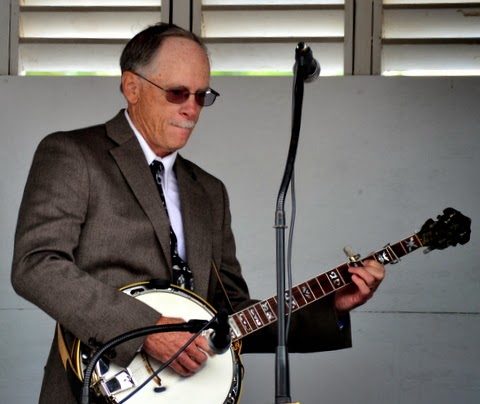
Andy Bing

Ken Meyer

Sean Quinn

Steve Wood


Smokey Greene

A bluegrass and country legend in New York, New England, and Florida, Smokey Greene is older than almost all of his audience. He once headlined many festivals with his band, which had an emotional reunion at Pemi Valley last year, and hosted his own festival in the Champlain Valley bordering New York and Vermont. Today he tours as a solo or accompanied by his son Scott, an able bassist and guitar player whose pleasant baritone voice blends well, as one might expect, with his father's. Smokey is best known for his nostalgic country songs and the amusing novelty songs he both resurrects (I'm My Own Grandpa, I Don't Look Good Naked Any More) and writes. Many of these are known to his loyal audience, which loves to sing along.

Scott Greene

Scott & Smokey Greene


Remington Ryde


Remington Ryde, originating in central Pennsylvania, has widened its national penetration playing at mostly smaller festivals along the east coast and into the midwest. They've also extended their visibility through hosting their own increasingly large bluegrass festival in Centre Hall, PA (near State College) and a budget bluegrass cruise in late fall, touting itself as "The Traditional Bluegrass Music Cruise." At Upper Hudson, we found their music uncomfortably loud, though competently delivered, and much of what passes for humor to be on the crude side, perhaps reflecting the influence of GoldWing Express, a regular at their festival and on the cruise.

Ryan Frankhouser

 Billy Lee Cox

Richard Egolf

Rich Kratzer

Greg Moore

Mountain Setting


Amy Gallatin & Stillwaters

Amy Gallatin is widely travelled performer who lived in a number of different parts of the country before landing in Connecticut. Her voice is perfect for the musical choices she makes which include songs carefully selected and often defying classification by genre...always tuneful and frequently uplifting. Joining her as a partner in music and in life is Roger Williams, known throughout the country as a Dobro player's Dobro player. His play is subtle and effective, not usually prone to the showiness the instrument encourages, but always tasteful and thought provoking. They are frequently joined on stage by Roger's son J.D., now entering his senior year at Berkeley School of Music, where he has distinguished himself, while becoming an increasingly self-assured mandolin player and singer. John Urbanek is always solid on bass. This band is entertaining and effective. They regularly tour in Europe as well as in this country and Canada.

Amy Gallatin

Roger Williams

J.D. Williams

John Urbanek


Beartracks

Beartracks, coming from the northenmost city in New York, Plattsburgh, has been a popular country band playing in clubs, bars, and local festivals around the region, originally with Junior Barber on Dobro and pedal steel. Lately brother/sister duo Tom Venne and Julie Hogan have broadened their reach and divided the band into a country band, featuring sometime electric guitarist Eric Gibson and known as the Clem Hawkins Revival Band and Beartracks, an increasingly effective bluegrass band playing traditional bluegrass and classic country. The addition of Harry Ralph on fiddle and Scott Hopkins on banjo has vastly improved the band. A recent appearance at Ron Thomason's High Mountain Hay Fever in Colorado has widened their exposure. This is an entertaining and highly enjoyable band, filled with energy and good humor.

Julie Hogan

Tom Venne


Harry Ralph

Scott Hopkins

Emcee - Donny Sprague

The Upper Hudson is an enjoyable, small bluegrass festival in the heart of the Adirondacks, which by mid-August is usually crisp and clear, lending a hint of autumn to the air while the black flies and mosquitoes are mostly gone. Promoter Rusty Leigh has carefully built his brand, which is mostly pretty traditional, and attracted a loyal audience. We were sorry to miss seeing the Atkinson Family, Zink & Company, The Seth Sawyer Band, the Katahadin Mountain Boys, and Higher Mountain who appeared earlier in the week, but found the day to be an unusually effective and enjoyable Sunday of bluegrass while we enjoyed steadily improving weather. If you're in northern New York, or nearby New England, the Upper Hudson Festival is an attractive choice for a day or a weekend of Adirondack flavored bluegrass music. Next year's festival will be held on August 14 - 16, 2015.

Smokey Green Joins Beartracks to Close the Show

Saturday, August 16, 2014

Herbie's Game by Timothy Hallinan - Book Review


Herbie's Game (Junior Bender #4) by Timothy Hallinan (Soho Crime, July 2014, 400 pages, $25.00/12.99) jumped up and grabbed me in the first two or three pages and kept me with the story and the character all the way through, leaving me hungering for more. I will surely read back in Hallinan's absorbing series, as I eagerly anticipate #5, and have already ordered his newest release in the Poke Rafferty series, with which I'm also unfamiliar. Hallinan has come up with an engaging character based on a unique premise that delivers strong situations, weird and attractive subsidiary characters, and situations usually encountered from the “other” side. How so? Well, Junior Bender is a burglar. His clients all live on the edges of society participating in their own criminal activities with enthusiasm and professional elan.

Herbie's Game opens with Bender in the midst of a burglary as he carefully enters, assesses, and, just as he's about to quit, finds a box containing two mysterious pieces of jewelry, one a Cartier broach familiar to him, and the other a small construction of strange beauty that he can't quite identify. This seems strange as we learn that his greatest asset is his fine eye for quality. “Ever since my mentor Herbie Mott taught me the rules of burglary, I've practically salivated at the sound of something rattling in a small box” thinks Bender, as he hear's a car returning, pockets the box, and quietly leaves by the rear door just as the homeowner returns.

Soon the reader is led into Bender's strange world of killers, fences, fortune tellers, thieves, and other underworld characters, many of whom have figured in his life and share a bond with him. He discovers that his friend and mentor, Herbie Mott, has died under extreme stress while being tortured to reveal...something. Coping with a deep sense of loss at the demise of a man he considers to be a surrogate father, the man who taught him all he knows about his “business,” Bender begins to trace a chain of messages leading to a contract murder through a series of “disconnections.” Each disconnect is carefully designed to build a wall of intermediary steps between the person who initiated the contract and the killer who carried it out. Along the way the reader meets a variety of people living on the “other” side of the law. We quickly come to see them as complex, lively, scary, and even likable people who transcend the cardboard cutout villains populating much crime fiction. They're articulate and funny as well as dangerous. Bender is a sharp judge of the human condition, making many trenchant observations that stop the reader in mid-paragraph to consider the idea and the language used to describe it. This is a sign of really good writing.

We soon meet Bender's ex-wife Kathy and his teenage daughter, the precocious Rina. Kathy describes Bender's appeal as lying in his “decency,” a quality the reader sees quite easily, too. He operates within a moral compass guiding his approach to his outlaw profession. He's an acute observer of the human condition while not making conventional moral judgments about his professional colleagues. The fact that they rob, kill, and deceive doesn't bother Bender if they adhere to the rules of the game as taught by Herbie, even if Herbie didn't quite adhere to them himself.

Timothy Hallinan


Timothy Hallinann lives about half of each year in Southeast Asia and the other half in California. He wrote songs and sang in a rock band while in college, and many of his songs were recorded by by well-known artists who included the platinum-selling group Bread. He began writing books while enjoying a successful career in the television industry. Over the past fourteen years he has been responsible for a number of well-reviewed novels and a nonfiction book on Charles Dickens. For years he has taught a course on “Finishing the Novel” with remarkable results – more than half his students complete their first novel and go on to a second, and several have been, or are about to be, published. Tim currently maintains a house in Santa Monica, California, and apartments in Bangkok, Thailand; and Phnom Penh, Cambodia. He is lucky enough to be married to Munyin Choy-Hallinan. (profile from Hallinan's web site). Hallinan has developed three successful series arcs. They seem to run their course after six books. Keep an eye out for the concurrent Poke Rafferty series set in Bangkok and, I hope, some more Junior Bender novels.

Herbie's Game (Junior Bender #4) by Timothy Hallinan (Soho Crime, July 2014, 400 pages, $25.00/12.99) allows the reader inside a crime novel through the eyes and mind of a criminal who views himself as a professional making a living rather than seeking to present the criminal as a socio-path devoid of human concerns and sensibilities. He sees his world with a high degree of clarity while being emotionally and professionally attached to it. Junior Bender, the protagonist of this series of novels, is humane, accessible, and enjoyable. Highly recommended. I read Herbie's Game as an electronic galley supplied to me by the publisher through Edelweiss. I read it on my Kindle

Friday, August 15, 2014

Country Isn't Country any More? - Essay

The essay below is a lightly edited version of my monthly column posted on the Welcome Page of the California Bluegrass Association's web page. As always, I am grateful to the CBA for providing me this forum and forcing me to spend several hours every month trying to think seriously about the issues and opportunities confronting our music. I look forward to entering into a discussion with all my readers on this one, either in the comments section or in the forums.

I've noticed recently at bluegrass festivals hearing bands say something like, “Does anyone want to hear a REAL country song?” which is always greeted with applause, even cheers. The songs, often covers of George Jones or Hank Williams, but including many other so-called Classic Country singers and songwriters, are very well received. I've begun to think that a major portion of the bluegrass audience is composed of country music fans who go to hear bluegrass because it's the next best thing available. Bands seem aware of this tendency and are including increasing numbers of country songs in their shows. This has got me thinking.....

I made a quick Google search “Country Music Isn't Country Any More” and got fifty-four million hits, so this doesn't appear to be an obscure topic in people's minds. Larry Cordle wrote a great hit when he claimed “Murder Was Committed Down on Music Row,” earning him the 2000 IBMA Song of the Year award. The song was later recorded by George Strait and Alan Jackson, reaching 38 on the country charts, although it was never separately released. David Peterson wrote about 1946 being part of “the best years of our lives,” although this nod to the 1946 William Wyler film, which won seven Academy Awards including Best Picture and is still one of the highest grossing films (adjusted for inflation) of all times, is a deeply ironic title, since the film deals with the difficulty three soldiers returning from World War II experienced in adjusting to peace. We live in a world where nostalgia for a past that never quite existed dominates our imagination, leading us to construct memories we don't really have.

Country music, music actually made on the front porches with guitars and fiddles, and parlor music have long existed. A.P. Carter collected many songs in the twenties and thirties, creating a family band which took advantage of the unique guitar style of his sister-in-law Maybelle to transition from truly folk music into the more commercial music that became known as country. Their music influenced all forms of country and gospel. Bluegrass emerged out of what became known as the great southern diaspora as rural Americans moved towards the industrial cities where the jobs were, taking their music with them, yet longing for home. Bill Monroe fashioned a fast-paced string band music which captured the yearning for a simpler time of dignified poverty (an oxymoron?) on the farm and in the church. His band consisted of what he could afford to travel with in a car, and he created a brand that became known as bluegrass, becoming a member of the Grand Old Opry in 1939, although his music truly emerged when Earl Scruggs and Lester Flatt created a sound revolution after they joined the band in 1945.

Monroe's career reflects that of a professional musician seeking a sound unique enough to allow his music to stand out and earn him living. His “true” story songs captured his views of an era already in the pre-war past. Much of his genius lay in his image making and self-promotion as much as in his music. The images still appeal, even though none is part of the shared experience of most contemporary Americans. But who will write with nostalgia about banks of solar collectors and the beauty of wind farms? How can they compare to the warmth of a crackling fire? How can ranks of huge combines crossing gigantic fields of grain provide beauty comparing to a lone farmer guiding a plow behind a horse? But who in suburban and urban America has this image in their mind as direct experience? What experiences fashion the imagination of today's budding song writers?

Gaining a Perspective: I made a brief search for a precise definition of Classic Country. It appears to me to be a classification for a collection of singers played frequently on certain small, rural radio stations which self-label their playlist as “Classic Country.” It includes performers from Hank Williams through Johnny Cash to outlaws like Willie Nelson and Waylon Jennings and extends to George Strait and Garth Brooks, whose comeback single concert in Chicago quickly expanded to ten dates in order to meet ticket demands. Tammy Wynette, Dolly Parton, Reba McIntyre and Emmylou Harris should also be included in the list. But...and here's the important realization, a majority of the recorded and performed material of each era is derivative, imitative, bland, and unworthy of being remembered, regardless of whether the work ever reached the charts, or was, for a brief period, wildly popular. Most of the people who recorded in country and bluegrass music, as well as all other genres, is truly better forgotten. But it often takes a generation or more for us to realize this.

One possible reason for the supposed reduction in the quality of music is the enormous demand for content made by the digital revolution. The Internet has made billions of people into massive consumers of content, including music. You Tube alone grows by 100 hours of video every minute, and is accessed six billion times a month. For the most part quality filters have been removed. Anyone can upload a music video or a book. There are no longer significant editors of written material or producers of music to make choices about what get published. By osmosis, a Gresham's Law of music and literature is in effect, that is bad music and writing drive out the good. Anyone can put out a CD and the remaining publishers are desperate to get out material that makes money. Of course, even in the heyday of the recording industry, there were many more failures than successes.

Similarly, in bluegrass, we all recognize, and most of us revere, the seminal pioneer bands. Bill Monroe, Flatt & Scruggs, the Stanley Brothers, J.D. Crowe & the New South pioneered musical styles, while the Bluegrass Album Band and the Johnson Mountain Boys came along at just the right time to revive these “classic” sounds just as they were fading from memory. Meanwhile, the New Grass Revival, The Country Gentlemen, and The Seldom Scene pioneered significant changes in the music, taking it in new creative directions. However, again, it must be remembered that more bands were unmemorable, better forgotten than played, and some of the Country Gentlemen, for instance the song about Bruce, seems trivial, dated, and in bad taste when considered as among their other great work. They did, and should, fade from memory. In every era of music, there have been creative geniuses who forged the way, along with imitators and copiers. Who knows which, in any particular era, will emerge and be remembered?

Who knows whether The Gibson Brothers, Balsam Range, The Infamous Stringdusters, The Punch Brothers or some other band will still be played and revered in a generation? Who knows what band, now seen as on the fringe, far away from the mainstream, will emerge in history as a trend setter, a new and creative voice influencing the next generation of musicians, and derided as “not bluegrass” or “not Real country?” Predictions can only be speculative, and most likely they are far off base. Much of the story will be told, and retold, after most of us are gone. Only time will tell.....