Thursday, January 20, 2022

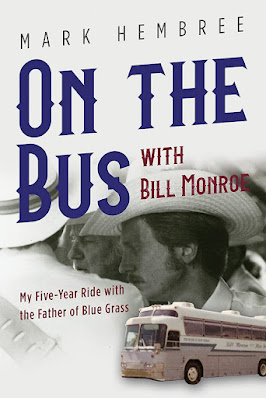
On the Bus with Bill Monroe by Mark Hembree - Book Review


It was the late seventies. Mark Hembree was an itinerant musician playing bluegrass with a Denver-based band called Monroe Doctrine. The band broke up, he moved back to Wisconsin, and a few months later happened on a chance to audition for Bill MonroeThe tryout went well, but he was still surprised when Monroe called a few days later and offered him the job. Two weeks later, he joined the band. That was the beginning of five years learning to work with the father of bluegrass music, a lesson that was never completely learned, always evolving and completely unpredictable. 

Hembree’s approach to writing On the Bus with Bill Monroe is anecdotal, and incidental, as if it were based upon stops along the way or incidents on the bus. Each brief chapter presents a complete incident illuminating an aspect of life on the road with Bill Monroe, his character, its hardships, quirks, strengths, needs, great vision, ability as a teacher, and sense of the immortality of  his music. 


Mark Hembree approaches Bill Monroe from a distance of forty years after spending five years in his band, using a macro lens to put a microscope on his experience. He adds nuance to his time with Monroe, putting the man’s life into perspective in ways that nothing else I’ve read about Monroe has succeeded in accomplishing. His writing is fresh, illuminating, open, and delightful.


Hembree’s chapter on legendary fiddler Kenny Baker may define his writing style as well as any. Instead of providing an encyclopedic discussion of  one of the defining fiddler's roles within the band, Hembree paints in haiku-like fine strokes, defining the man, his music, and his greatness. If I want to learn more, this provides me with the platform from which I can dive but it’s all I need to know to begin to understand the importance of Baker and his music to Bill Monroe.


Meanwhile, encounters with Monroe himself illustrate all the strengths and flaws that come together to make up his genius. His tight-fistedness alongside his sometime generosity, his flintlike hardness beside his sometimes warmth and understanding, his commitment to his originality and awareness of change. And so many other internal contradictions making up this complex genius.


More than one hundred and sixty musicians came and went during the history of Bill Monroe and the Blue Grass Boys, some became famous in their own right, others are hardly remembered today. Each contributed in some way to the legend of the man and the music. But Bill Monroe assured the purity of his music, retained a constancy uniquely his own, always recognizable, whoever was in the band, no matter where in they were, from the smallest Appalachian village to Jerusalem, to the White House.


Mark Hembree


Mark Hembree joined the Blue Grass Boys in 1979 after a stint playing bass with Monroe Doctrine. He played with the Monroe until 1984, when he joined the Nashville Bluegrass Band as a founding member with Alan O’Bryant, Pat Enright, and Mike Compton. After a bus accident, he retired to a publishing career in Wisconsin and now edits and writes as well as playing bluegrass with the Mark Hembree Band and western swing with the Best Westerns


Bill Monroe & The Blue Grass Boys play Rawhide

at

The White House - 1980


Many books have sought to capture the quality of the man who created such an enduring legend, planted such vibrant and rich seeds, commanded such fear and respect. There’s almost an industry of scholarly study devoted to discovering the real Bill Monroe. Perhaps the incidents and anecdotes Mark Hembree brings together with his light, mostly humorous touch do as good a job as any of the much heavier pieces of serious scholarship. He presents a complex genius who emerged from poverty, illiteracy, and the Great Depression with a massive chip on his shoulder as well as great, unrecognized ability, fighting for every advantage he could achieve. The details are available in the many books. The core personality emerges in the stories lovingly, humorously, and admiringly told by Mark Hembree. On the Bus with Bill Monroe: My Five Year Ride with the Father of Bluegrass Music by Mark Hembree is published by the University of Illinois Press, a volume in the series Music in American Life. It is available in April of 2022 from all the usual outlets.


Monday, March 29, 2021

Vinyl Ventures: My Fifty Years at Rounder Records by Bill Nowlin


In many ways the story of Rounder Records (Vinyl Ventures: My Fifty Years at Rounder Records by Bill Nowlin (Equinox Publishing, April, 21, 2021, 320 pp, $29.95) and the story of bluegrass music grew together when three college students from Tufts University began heading to Appalachia during the 1960’s to enjoy, record, and collect this music. Now, Bill Nowlin, one of three Rounder Founders has written the entire story of Rounder Records from close up. The book shows some of the quirks and idiosyncrasies of a writer broadly interested in the world of music and a world beyond, without ever losing its focus on the birth, development, and integrity of its subject, a record label of distinction and longevity.


Rounder Records, founded by Bill Nowlin, Ken Irwin, and Marian Leighton Levy in 1970 was unusual for independent labels in having three founders with different tastes, who sought out music to record from a wider palette than many early independent labels. Rounder emerged just as a yearning to discover the roots of the then popular folk revival was cresting. The three Rounder Founders set out to find, record, and collect the music of those roots, at first in the American South, but soon expanding to a much wider, more comprehensive world.


Rounder Founders

Marian Leighton Levy, Ken Irwin, Bill Nowlin


Reading about the early adventures of the Rounder Founders is a little bit like watching puppies playing in their infant box when one considers the size Rounder grew to, and the speed with which it achieved a level of maturity. They hitch hiked to North Carolina and Virginia, haunted record stores in Greenwich Village in Lower Manhattan, attended live shows at small venues, earned free tickets by promoting those shows, built a cut-and-paste recording business at little or no cost, all as an adventure without thought to making it a career. As many of the other new labels left folk music for rock and roll, the field opened to allow three dedicated young Boston students who hung with what they loved, to begin to prosper. It’s the story of three “counter culture” kids doing what they loved with passion and conviction while discovering a lifelong enterprise that worked out for all of them. 


In the early 1970’s, the recording industry was still pretty informal, especially among the multitude of independent, one person operations. Rounder benefitted from having three partners who worked hard while trying to be fair to artists and buyers simultaneously. Over time, and with added success, they remained true to their original ideals while, of necessity, having to become better organized and more businesslike. Nevertheless, for those who know them, the Rounder Founders still give off a whiff of counter culture kids from the late sixties and early seventies. There’s an informal construction to the book, as early friends pop in with memories along the way. Reading the book often feels like a conversation with many people from many eras. 


Originally collecting, recording performances, and producing these often rather highly specialized recordings focused on previously obscure performers in Appalachia, expanding to early bluegrass festivals and musical gatherings. Over time, their interests took them to cajun and zydeco in Louisiana, reggae and ska in Jamaica, and to Africa for both traditional and contemporary music. All of this became a part of what turned into an international catalog of over 3000 recordings. Meanwhile, the Founders always took care to represent the interests of the performers in terms of both publication and payment. In order to accomplish these sometimes contradictory goals, they took extra care in choosing partners to collaborate with.  


In order to manage this huge collection, Rounder’s business model had to expand as they kept tight control over their expenses. Rounder grew into both a recording company and a distributor, eventually leading them to partner with many other small companies to become a major distributor of niche roots music labels. The Founders learned to be nimble and innovative, while always looking out for the welfare and artistic/economic welfare of the artists they signed. During these periods of expansion, challenges, and opportunities, Nowlin’s narrative describes in detail the corporate interactions and complexities, often with the help of long lists. 


Ken Irwin expressed the criteria the company used for selecting music to record, saying, “There are three things we look at when we’re signing artists. One, do we like the music and do we feel that it will hold up over time? Two, do we like the people and their representation? Three, do we think we can make money from it?” Furthermore, if the music doesn’t pass the first test, the next two questions were never even asked. (p.204) As the music recording and distribution environment changed after the introduction of the CD, to digital online distribution through iTunes, Spotify, satellite radio, the role of music publishers and labels became increasingly less prominent. Rounder’s practice of being both a promoter of historic, regional, or local performers became viewed as important but less commercially viable. As such, their business changed as they focused on identifying excellence, publishing materials only available through national archives or private collections. 


I read Vinyl Ventures in a print edition with Spotify and YouTube at hand, so I could sample the albums and/or performers Bill Nowlin writes about in his clear, informal, narrative style. The e-version has built in links taking readers directly to Spotify versions of the music. Digital Sources often provided me with a setting for the places where the music was made in addition to providing invaluable insights into the range of music Rounder recorded. I was able to find and hear every artist I looked for on one or the other outlet, but I can’t verify the availability of every one. Nevertheless, since it’s inevitable that many musicians referred to in the book are unfamiliar to many readers, using such sources increases the pure pleasure of this book. 


Bill Nowlin


Bill Nowlin is the author or editor of nearly 100 books ranging from this history, through other books about music, more than twenty titles concerning the Boston Red Sox, other baseball titles, political history, fiction, and more. He is a graduate of Tufts University and the University of Chicago, as well as being one of the original three Rounder Founders. He taught Political Science at UMass Lowell from 1970 - 1982. A member of the Society for American Baseball Research, he claims to have traveled to more than 130 countries, but says there’s no place like Fenway Park.


Rounder Founders


One of the many delights of Vinyl Ventures lies in Bill Nowlin’s seemingly idiosyncratic asides into his travels, love of baseball, and other interests. One particularly useful segment describes the decline and fall of both the recording and book publishing industries to the allures and dangers of digital publishing found on pages 249 - 254. These five pages alone, devoted to the world’s digital environment changing before our eyes would make the whole book worthwhile, even if so many other delightful insights, observations, and useful elisions didn’t exist. 


For a person whose experience with Rounder Records grew from encountering bluegrass music relatively late in life with limited familiarity with popular folk and country music, encountering a book like Vinyl Ventures is simultaneously a daunting experience and a mind-opening revelation. The range of enthusiasms, deep scholarly exploration, and sometimes daunting physical challenges, even exposures to danger in order to collect and catalog a significant portion of the world’s music, is difficult, at best, to describe. Bill Nowlin with an expansive writing style sometimes losing track of chronology captures the courage, imagination, and capacity for risk taking, both personal and financial, the Rounder Founders exhibited in building their company.


A problem with books like this one is the possibility of becoming mostly a list of artists recorded, trips taken, awards won, problems overcome, and changes made. All those elements lie within this highly readable account, yet it includes the human experiences of the Rounder Founders as they built a recording empire based on their enthusiasms while including the broad range of interests they pursued. Their recorded music and choice of artists reflected and taught the world the broad range of music and cultural experience available, exposing the musical roots of who we are as people and who we can become. Therein lies the thrill and the charm of Vinyl Ventures. 

Friday, March 12, 2021

Blue Latitudes by Tony Horwitz - Around the World with Captain Cook


Most people are aware of a mid-eighteenth century British explorer named Captain Cook. Fewer of us know that he was the first person from the West to visit the extensive island chains in the Pacific Ocean as well as to explore and map the outlines of Australia and New Zealand. Fewer still know of his huge influence on later explorers, exploiters, and developers of a world-wide view or the development of what became the British Empire. Tony Horwitz in his marvelously informative and entertaining travel cum history book Blue Latitudes: Boldly Going Where Captain Cook Has Gone Before (Henry Holt & Company, 2002, 480 pages) brings the man, history, and the present together to provide lots of answers while raising not a few issues and some additional questions in a hugely entertaining and informative volume. 


Cook's Ship - Endeavour


As a narrator seeking to write a serious account of Cook’s three voyages of exploration, Horwitz carefully describes the context and times of Cook’s explorations while including how these widespread Polynesian peoples have adapted to and been corrupted by the modern world. To do this, he decides to visit the places Cook visited. To add spice for the reader as well as a companion for himself, Horwitz invites Roger Williamson, an old friend with whom he has travelled and sailed before, to accompany him on his voyages. The contrasting viewpoints, perspectives, and lifestyles between the two men provide humor as well as insight into the world Cook uncovered and the way these far-flung islands have developed as they encounter the modern world. 


James Cook, 1728 - 1779, during three voyages to the Pacific Ocean explored and mapped from the edges of Antarctica to the northernmost navigable waters on the Western edge of North America. He was particularly noted for his navigation skills, which provided maps still in use into the early twentieth century. He proved himself to be a remarkable leader - resourceful, relatively humane and brave. He discovered and/or mapped lands unknown to exist before he arrived, and extended the available knowledge of places already touched. While this book is not a biography, a picture of a smart, resourceful man who would not, under other circumstances, have had the opportunities, because of his humble birth, to rise to command or encounter the difficult situations in which he thrived.


Cook Entering Kealakekua Bay

by

Herb Kane


Horwitz’ book skillfully moves between accounts taken from Cook’s captain’s log and other writings as well as the writings and art of other members of his crew and adventurers who were carried aboard ship, possibly to help defray the costs of the voyage itself. In these segments he accounts for the “unspoiled” islands and their relatively primitive inhabitants. Then he spends time ashore meeting local inhabitants, both former visitors who have been attracted to the Pacific islands through readings and pictures of the lifestyle there who came to visit and stayed, as well as long-time peoples who have settled there earlier. The indigenous population, by this time, no longer contains very many, if any, pure Polynesian descendants. The cross cultural stories of exploration, exploitation, epidemic, and genetic melding create new societies as the tragic disappearance of a traditional peoples’ culture continues.


Tony Hurwitz


Tony Horwitz (1958 - 2019) was a Pulitzer Prize winner for his reporting on low wage working conditions in Wall Street Journal. He also wrote for The New Yorker as well as publishing several books. Sadly, he died suddenly while on a walk in 2019. He was sixty years old. 


Blue Latitudes: Boldly Going Where Captain Cook Has Gone Before (Henry Holt & Company, 2002, 480 pages) provides interested readers with variety, enrichment, humor, and vision by showing the primitive paradise Captain James Cook found on his voyages in contrast to the diverse, complex societies which have developed in modern times. Readers of travel as well as those interested in primitive cultures and their introduction to the modern world will find this book a fascinating and worthwhile voyage of discovery for themselves. 


Monday, January 18, 2021

Wartime Farm - An Historical Recreation


Nostalgia has a strange and funny effect on people. We often yearn for the “good old days,” finding something strange and wonderful about a golden past we yearn for, whether it existed as we remember it or not. At other times, our nostalgia may cover up many less pleasant or difficult times with a rosy glow. My wife, Irene, and I were both born in 1941, about six months before the Japanese attack on Pearl Harbor precipitated America’s entry into World War II. However, the war had been raging in Europe for two years before our formal entry, even though the U.S. was supporting England with weapons and material. We both lived through the war as small children, each of us having fleeting memories of crushing cans, saving rubber bands, and ration books limiting the availability of gasoline. This series brought back some real and, perhaps, some media coached later images to our consciousness

Manor Farm


The BBC production of Wartime Farm, recreates the British farmer’s experiences of the War, bringing its hardships, advancements, and struggles to life in an arresting, revealing, and engaging eight episode documentary bringing realities of the war as it affected life in the English countryside to reality. Currently running on Britbox, this highly engaging eight episode program, filmed at the living museum Manor Farm, contains many points of nostalgia while never glossing over the hardships, dangers, and changes the war brought about in English rural society. 

The Cast

The main characters in the film are Historian Ruth Goodman and archeologists Alex Langlands and Peter Ginn, who work the farm together, learning the farming and domestic skills necessary as well as confronting the hardships of farm life during the war. While all the filming, except for black & white film clips from during the war, is clearly contemporary and all the characters in every role are re-creators/interpreters, there’s an almost overwhelming sense of authenticity, as the three central characters learn to live in a time period clearly taking place before they were born. 


Wartime Farm is currently streaming on Acorn TV, which can be ordered separately or through your Amazon Prime subscription for $5.99 a month. An annual subscription is available directly from Acorn, saving subscribers two months payments. We’ve found it to be intensely interesting in its own right as well as creating cultural and historical context for much of our current streaming of British television programs portraying various aspects and post-war time periods. Even programs like the Inspector George Gently Mysteries, set during the 1960’s show elements of the effects of World War II in their action. The Inspector Lynley Mysteries, too, take on greater nuance when the class structure explored there is put into a context of post World War II England.  


All in all, Wartime Farm provides fascinating glimpses into social and cultural changes made in England during the 1939 - 1945 period which still resonate through the culture, while never losing its intrinsic entertainment value. Presented in eight episodes, the program offers glimpses into a life fast disappearing from living memory, yet crucial to the modern world. 


Monday, December 14, 2020

Rascally Mountain Boy by Marc Pruett - Book Review


Nostalgia means looking back at earlier times through the gauzy haze of many years, making much that happened in the past preferable to today’s sometimes awful reality. “Remember when the times were so much better than they are now,” remains a constant lament of the mildly to wildly unhappy living in today’s complex, challenged world. Nostalgia, however, can also serve as an appreciation of the events, behavior, and circumstances from the past serving to form the views and understandings through which  individuals see the world, forming their own values and behavior. Memories mix with character- building and appreciation of today to form what, for want of better words, forms our life experience. It’s within this context that musician Marc Pruett has written Rascally Mountain Boy - A Lighthearted Memoir (Life, Music, Songs), a delightful collection of stories, memories, and reminiscences from his childhood, touring career as a well-regarded banjo player, and triumphs with major bands. In short, well-written, charming, and insightful glimpses at life and living, Marc Pruett offers a book filled with warmth, reminiscence, memories of many bluegrass greats, and wisdom in a book built for people who enjoy reading in small bites. 

Part I of Rascally Mountain Boys contains stories from Marc Pruett's childhood memories and experiences, told in a folksy, friendly, and winning manner drawing the reader into the world of mid-twentieth century rural North Carolina. He then turns to engaging stories from his long and successful career as a professional banjo player, including fronting his own band. Marc’s description of how Jimmie Martin broke him in as a young banjo player, molding his delivery to match what Martin was looking for from the banjo is the best Martin profile I’ve ever read. It adds dimension to my understanding of Martin as a performer and a leader as well as showing how a young banjo player learned his trade in those days. Part II consists of stories built around songs finding memories of real life events evoked from songs in his own life. Finally, he looks at songs he himself has written, showing how the meaning of each reflects incidents in his life and values he holds dear as well as the song-writing process itself.

                                                                     Marc Pruett Demo at IBMA

Marc Pruett was born and grew up in Haywood County, North Carolina, an area dominated by the Smoky Mountain National Park, small towns, the paper industry, and bluegrass music. Born in 1951, he was nurtured in rural living, growing up in an idyllic rural environment where it was safe for young boys to explore, test themselves, and get into more than a little mischief. His professional career started when he was fifteen years old, and soon he began reaching further afield to play with the bluegrass greats of the sixties and seventies, bands like Jimmy Martin’s, James Monroe, and Ricky Skaggs, where he earned a Grammy Award for his participation in the album Bluegrass Rules, one of the five albums he played on while with Skaggs. As is true of many musicians, he also had another career, working in local and regional government in environmental areas. (Marc Pruett Interview by Wayne Peeler) In recent years, Marc received an Honorary Doctorate from Western Carolina University for his contributions to bluegrass music and regional culture. For more than a decade has played with Balsam Range, which began in the Ashville, NC area, founded in 2007, and has risen to national acclaim, twice winning the IBMA Entertainer of the Year Award as well as wider recognition. (https://en.wikipedia.org/wiki/Balsam_Range) 


Balsam Range - Caney Fork River


Rascally Mountain Boy by Marc Pruett is a delightful book, perfect for light reading and dipping into when time for concentration is not needed. It successfully captures rural America in the mid-twentieth century, celebrating the simplicity and values of that era. Readers will find evocative memories as well as keen insight into the period and life of growing, rambunctious boys. It also reveals how a regional. Appalachian folk music grew into a national voice for rural life not available to everyone. I highly recommend it. You can purchase a copy through the Balsam Range Website.


Monday, November 9, 2020

The Queen's Gambit - Netflix Series Review


What could be exciting about a little girl in an orphanage learning to be a chess player and following her progress as she becomes a prodigy on her way to world class competition? I’m not interested in chess. We don’t often watch “women’s” dramas. Who cares about lost orphans? Well, I dare you not to binge this magnificent drama which becomes a metaphor for the game of life - its joys, dangers, pitfalls, and searches for meaning. The Queen’s Gambit, currently streaming on Netflix, will provide you with a hugely satisfying coming of age story about a remarkable young woman as well as a new appreciation of the dramatic possibilities found in a game in which two people sit opposite each other for hours with all the drama taking place in their heads.

 Anya Taylor-Joy as Beth


The story begins as nine year old Beth Harmon, played as a child by Isla Johnson and later by the remarkable Anya Taylor-Joy, arrives at a cold, rule-encrusted, emotionally stark orphanage in rural Kentucky. An impressionable and repressed little girl with little understanding of the world she is entering, Beth seems shut off and lost. She soon finds her way to the school’s basement, where the school janitor, Mr. Shaibel, played by Bill Camp, silently plays through chess problems between times spent sweeping floors and changing light bulbs. Beth asks about the game, which he quietly and patiently introduces to her, while discovering that she has remarkable aptitude for the game. She has also discovered a refuge for emotional and intellectual support that will become a foundation for her story.

Eventually, Beth is adopted by a cold, distant couple, and raised by her doting, but alcoholic mother, who gladly live off her daughter’s increasingly successful chess career leading to fame, money, and increasing international prominence. As Beth’s story continues, chess is always prominent, somehow becoming both a frame and the story’s centerpiece, while never becoming exceedingly formulaic or cliched. On the contrary her triumphs at the chessboard set the frame for her struggles with drugs, alcoholism, and relationships. 


So, let’s take a look at chess as the centerpiece of this fine film drama, according to Dylan Loeb McClain, former chess columnist in the New York Times. He says that the setting is eerily reminiscent of chess tournaments around the time in which the film takes place, one of the many reasons that the series is one of the best and most successful screen adaptations of the game.” I can add that for a person who was in high school and college during the period the series portrays, there’s a clear familiarity. The actors were trained to avoid chess mistakes to the point of learning to move chess pieces the way real players do. Even the games are real recreations of actual competition. McClain points out parallels with the great American chess champion Bobby Fisher, while suggesting that making the protagonist of this series a woman is not only dramatically satisfying, but represents a rebuke of Fisher’s often sexist remarks about women in chess. While voicing some criticisms of the series, former world chess champion Gary Kasparov says, “But trust me,” he said. “This is as close as one can have it.”


Actress Anya Taylor-Joy commented that learning to communicate the passion engendered by chess as well as to control the movements on and around a chess board were relatively easy for her to master as she compared them to her own passion for dance, also seen in Beth’s self-discovery through dance music in the show. Beth’s increasingly rich relationships with chess players who undertake to teach her while eventually falling to her in chess competitions and for her as an increasingly alluring woman become a centerpiece of this drama.  Taylor-Joy truly inhabits the role.


The Queen’s Gambit, the name of a chess opening as well as of this delightful film series, takes its time, which is one of its glories. The camera lingers, moods evolve, problems present themselves and then are slowly and thoughtfully resolved. Meanwhile, the sense of movement and action keeps attention high. This series is never hampered by the chess setting, whether you know the game or not. While I fall in the “not” category, just barely knowing how each piece is supposed to move with no sense of the complexities of the game, the growing excitement and tensions within Queen’s Gambit kept me involved throughout. I highly recommend it to adherents of first rate, cerebral drama. 

_______________