How to Thrive at Merlefest
In the years since its founding in 1988,
Merlefest has become the brand name for acoustic music festivals along the east coast and across the country. It attracts visitors from around the world to Wilkes County, North Carolina in the last weekend in April and has contributed huge amounts of money to its sponsoring institution, Wilkes Community College. Begun as a small event to celebrate the life of Eddy Merle Watson, Doc Watson's son, who was sadly killed in a tractor accident, it has become a giant event, attracting tens of thousands of music fans and the best practitioners of acoustic music each year. Now, with fifteen stages ranging from the huge Watson main stage to the tiny Plaza Stage and out-of-the-way venues like the Mayes Pit and the Lounge, Merlefest presents a sometimes daunting and always interesting logistical problem for attendees wishing to get the most from four days spent there. If there are 15,000 people on campus on a given day, there are 15,000 different festivals going on. This post is designed to help people attending Merlefest use the resources available to get the most possible enjoyment from their time there. We first attended in 2003, and a new world of musical experience and excitement was opened to us. Our wonder at its breadth, diversity, and excitement has not wained. The festival has changed, matured over the years, but its commitment to celebrating the traditional while introducing and advancing the new and innovative remains a central aspect of its appeal, first ennunciated by Doc himself. I hope this small guide provides some assistance.
Watson Stage
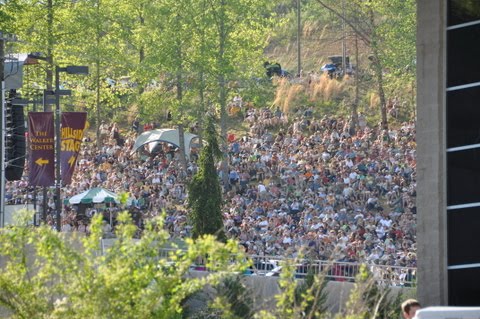
Crowd at Creekside Stage
The Music: A look at the Merlefest
list of performers and acts scheduled for the Watson Stage suggests the direction Merlefest sees itself going. The overall list of performers contains many Merlefest favorites (of course Doc Watson as well as Sam Bush, Peter Rowan, George Hamilton IV, David Hold, the Kruger Brothers, Pete & Joan Wernick and many others), many of whom have been performing at Merlefest since its beginning. You may, however, have to hunt around for the venue where you'll be able to see these historic figures as newer and more youth oriented acts tend to dominate the large venues. Merlefest has also proven itself to be a bellweather at identifying and recognizing rising figures in acoustic music. This year many bands we haven't heard of or seen are on the schedule. They include: The Gravy Bros, WPA, Johnson's Crossroad, and many others. Also included are bands we know and seek out in our own festival rounds: The Gibson Brothers, Balsam Range, The Greencards, and the Steep Canyon Rangers, this year featuring Steve Martin. Other attendees will find their favorites as well as other bands they've wanted to see but not had the opportunity yet.
Sam Bush
Tut and Lee Taylor at Plaza Stage

The Watson Stage performances through the four days of Merlefest suggest a direction the festival is taking. In the years we've attended Merlefest, only one Sunday closer has kept the grounds filled late into Sunday afternoon. When Alison Krauss and Union Station closed Merlefest a few years ago, you couldn't see the back of the audience! In recent years, Sunday has featured nostalgic performances by aging artists. Last year's mariachi program by Linda Ronstadt and a troupe of Mexican singers and dancers signalled an important multi-cultural statement but couldn't hold an audience. This year, Merlefest is being closed by the Avett Brothers, a highly entertaining group with huge appeal to younger audiences. Other Watson Stage performances on Sunday afternoon include The Lee Boys with the Travelin' McCourys and W.P.A., an indie band including Sean Watson, formerly of Nickle Creek, and Luke Bulla, who has performed with Bela Fleck and Jerry Douglas. This afternoon of music, along with the very energetic celtic band Scythian will be loud, rock-tinged, plugged in, and attractive to a much younger demographic than Sunday has traditioanlly offered at Merlefest.
The Local Boys on the Cabin Stage
The Food Tent

Another feature of the Watson Stage, where performers are confronted with sixty rows of reserved seats appears to be that younger groups with a youthful appeal are scheduled there before 5:00 P.M., when seats are open to all. Remember, when the owners arrive to claim their seat to gracefully and quickly relinquish it. Evening groups, when the reserved seats are truly reserved are set aside for audiences who seek a more traditional or familiar experience until the last performance, when, if there's a mass exodus, the emcee often invites all in again. Main stage evening performances feature Taj Mahal and Rhonda Vincent & the Rage on Thursday, country singer Dierks Bently featuring the Travelin' McCourys as well as Daily & Vincent and Sam Bush on Friday, and Elvis Costello followed by The Steep Canyon Rangers featuring Steve Martin on Saturday. This scheduling should keep these seats pretty well filled for most of the days. The large jams featuring several bands performing together seem to have been eliminated. The My Friend Merle set, formerly found on the Watson Stage has been moved to the indoor Walker Center, perhaps as an accomodation to Doc Watson's age. People wishing to see Doc perform this year will need to seek him out.
It May Rain, But There's Always a Rainbow
Use the Map: The Merlefest Map on line has been vastly improved and made much more usable. By making it more to scale and allowing readers to zoom in on various parts of the map, Merlefest has provided a clearer idea of how the WCC campus is laid out and how to navigate from venue to venue. The only problem lies in the absence of topographical detail. The Watson stage and many important parts of the campus lie on a flat plain surrounded by rather steep hills. To move from, say, the Watson Stage or Creekside to The Walker Center or the Hillside Stage requires not only a walk, but a climb. People planning to attend a performance at Creekside and then move to the Hillside Stage must allow about half an hour and be prepared to climb several hundred feet. Thus, conditioning becomes a factor.
Hillside Stage Crowd for Album Hour
Hillside on Sunday Morning
Study the Schedule: The Merlefest Web site has the complete schedule and makes it available as a
PDF document. Download the schedule and study it! The schedule will take 12 pieces of paper and some ink, a good expenditure if you wish to use your time well during Merlefest. You can waste hours of time standing in the middle of the campus trying to decide which way to turn and where to go next. While you don't want to be in a constant rush at Merlefest, you do want to attend as many musical events as you can while also enjoying the ambience, getting enough to eat and drink, and putting aside time to get some rest.
Browsing the Shoppes at Merlefest
The Expo Tent
Shopping at Merlefest: The Expo tent at Merlefest is the place to shop for instruments and instrument accessories. Top manufacturers of all major acoustic instruments have booths at Merlefest, either in the Expo tent, behind it on the path to the Creekside stage, which is sponsored by Gibson, or in the much larger Shoppes at Merlefest area, which is a sort of mall. All these venues can offer pretty good bargains. The Merlefest Mall where CD's and other band memorabilia can be purchased, on the other hand, is quite expensive, since a $3.00 premium is added to all merchandise in support of the Wilkes County Chamber of Commerce. This puts buyers in a tough position, because there's a huge choice of CD's, t-shirts, and DVD's available from most Merlefest performers. Saturday afternoon is often a good time to shop for new instruments in the Expo tent, as many dealers and manufacturers would rather make a good deal than carry merchandise home with them. There's also a crafts tent selling higher end crafts, including some very good instruments. Some instrument vendors prefer The Shoppes at Merlefest as a sales venue, perhaps because space costs less there. Regardless, there are plenty of vendors selling very good instruments available at Merlefest if you're in the market for one. There's also clothing, art work, crafts, and much more available. Shopping at Merlefest is fun and provides a break from music, if you want one.
The Plaza
Jamming Area
Eating at Merlefest: A few years ago, in an effort to provide more green space and distribute the crowds more evenly, food vending was somewhat decentralized. The main food vending tent is a huge circus tent to the left of the Watson Stage. A number of organizations including churches, Wilkes Community College student organizations, and service clubs sell food ranging from snacks and coffee to full meals. Meal service includes barbecue pork and chicken, spaghetti, Thai food, and more. The food is well-prepared, tasty, and reasonably priced. This tent is exceptionally crowded during dinner meal breaks. At other times, the lines are fairly short and move well. Time your eating away from the breaks and do yourself a favor. There is lots of seating under the tent, and it's near enough to the stage to be able to hear well and eat at the same time. There's also food service near the Shoppes at Merlefest including excellent coffee, hot dogs, ice cream, and so-on. Near the children's activity area, including the Little Pickers Tent, food more desireable to children is sold, including such fair fare as funnel cakes and corn dogs. Many people bring their own food into the festival in coolers or back packs. Please remember that all carry in bags (including cameras and baby tote bags) are subject to inspection. Any alcohol or illegal drugs will be confiscated. I only wish they'd do the same for tobacco. No such luck, but smoking is supposed to be severely restricted. There are spaces set aside for smoking, but then, smokers don't like to breathe other people's smoke either. Anyway, there are plenty of food choices and the price is right for this kind of venue.
Pre-Festival Jams Sponsored
by
Wilkes Acoustic Folk Society
The Late Donnie Swaim and Wife Lynn at Jams
Jammin'
Rest Room Facilities: There are plenty of porta-potties spread out over the festival grounds, and they're kept remarkably clean by the several roving pump trucks available. Also, many of the campus buildings are open with clean rest rooms in an air-conditioned environment. In recent years, the fetival has also provided portable flush toilet facilties, which are also cooled. These tend to get long lines, especially on the women's side, so don't hesitate to use those little blue plastic conveniences. They're just fine.
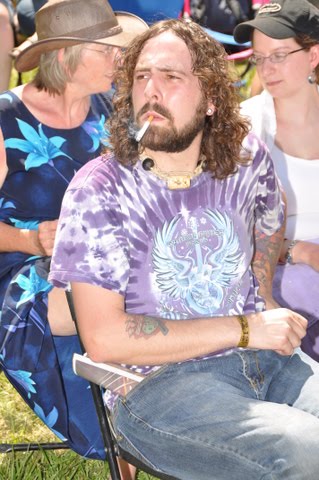
Smokers Persist
The Plaza Stage
Weather: The Wilkes Community College campus features a flat plain where the Watson Stage and many other stages are located surrounded on two sides by quite pretty hills, one with campus buildings rising up from them and the other featuring very nice housing. Wilkesboro is set on the eastern edge of the Smokey Mountains. The festival is held the last weekend in April Springtime in Wilkes County can be counted on to feature variable weather and you can expect quite a range of it during the four days of Merlefest. On sunny days, the campus can be very warm. If it's clear, when the sun goes down a chill, damp miasma will flow into the Watson Stage area allowing the air to become quite chilly. We've experienced temperatures from the mid-eighties down into the low forties on the same day. We always come to the campus with three or four layers of clothing, sun block, and plenty of water to help us stay hydrated. The most important items of clothing are dry warm socks and a winter cap. Keep your extemities warm and you can keep fairly comfortable at night.
Alberti Flea Circus
Little Pickers
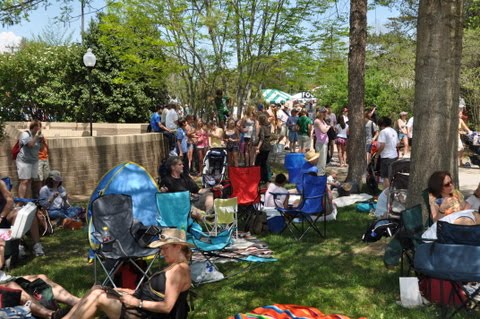
Small Joys: It's easy to allow yourself to be enticed by the big stages and big names. Action on the Watson stage, the Album hour on Saturday afternoon at Hillside, or the closer intimacy of big-time bands at Creekside all claim large audiences. However, there are smaller and more humble venues at Merlefest which can yield wonderful and surprising joys. The Little Picker's tent provides a place for young performers to strut their stuff and name performers to present music for children. Stop by there to check out the next generations of musicians. While you're there, look for the Alberti Flea Circus and watch Mr. Alberti put his tiny charges through their paces. Take a look at the delight on the faces of young and old. Look for the jugglers and stilted giants walking about the grounds. Spend some time watching the annual sand sculpture grow towards completion. Go to the Traditional tent to hear cloggers or shaped note singing on Sunday morning. Visit the jamming area sponsored by the Wilkes Acoustic Folk Society. Stop at the Plaza stage to say hello to Tut Taylor, at age 86 still a wonder and an innovator as the “flat picking dobro man.” Spend some time wandering the grounds doing some good solid people watching. What a bunch of wonderful and diverse characters attend Merlefest!


Last year Merlefest took a significant financial hit, along with all the rest of us, when the economy was so scary that many people just couldn't take the chance of spending the amount of money this huge event costs. This year the people who do the thinking appear to have changed the demographic focus, particularly on Sunday, to attract and hold a younger, and perhaps more affluent, crowd through closing on Sunday afternoon. One can only hope this gambit succeeds. In the end, Merlefest still represents the goals set by Doc Watson in the beginning, to offer “traditional plus” music. While the overall sound has become increasingly contemporary in recent years, the traditional is still clearly there while the range of music growing from the traditional has expanded and come to dominate the festival. The mixture remains interesting and compelling.
Mando Mania at Creekside
R & R Tend
Sand Sculpture by Sandy Feat