
On Saturday we drove up to Thornton, NH to attend the Pemi Valley Blugrass Festival for our first time and since their move to the Sugar Shack Campground, the twenty first year of this very fine festival. From ourappearance at the festival office tent to our leaving just after curfew at 10:00 PM, were treated as long lost family members as we were welcomed and introduced to the marvelous facility having enormous potential for development into a world class home for a well-run, jammer and listener friendly bluegrass festival. Promoter Sue Marsden, along with her able aides Craig Engle and Steve Abdu as well as a helpful and capable crew of volunteers made the day a pleasure for us and the entire group of performers and campers.
Parker Hill Road Band

The Parker Hill road band offers a very pleasant combination of traditional bluegrass mixed with bluegrassed more contemporary music. They feature tight four part harmonies and quality instrumental work characterized by good timing and listenability. They offered a good start to a fine Saturday at 10:00 AM.
Tom Rappa

Mike "Woody" Woods

Paul Ambry
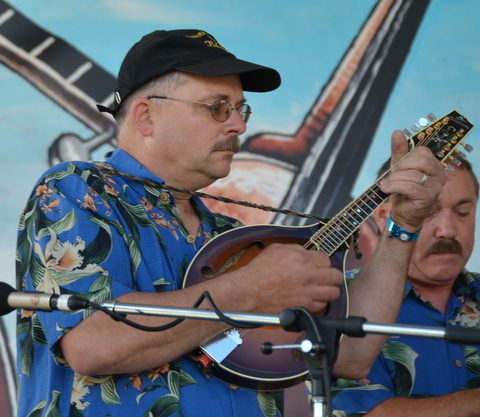
Chris Cate

The Bridge to the Primitive Campground

The Sugar Shack Campground has recently received its state campground certificate and has plans for improvements which will never compromise the natural beauty and setting along the Pemmigewassett, which originates in the White Mountains of New Hampshire, flows through Franconia Notch to merge with the Merrimack River later. The resulting "Pemi" river, as it is known, has created a verdant river valley which provides a convenient route for I-93 to bring visitors to the summer resorts and winter skiing in northern New Hampshire as well as easy access to the Pemi Valley Bluegrass Festival. Back along the river, many large, quiet campsites can be found for family camping, bluegrass fellowship, and picking. There are open meadows convenient for larger campers seeking less privacy. The campground has a few electric hookups, but no water or sewer sites. Plans are afoot, we understand, for a bath house and a few other amenities, but simple camping and the attractiveness of nature are the major attractions here...plus the music. The festival provides a shuttle bus to jitney campers to the main stage, but it's an easy and pleasant walk through the woods. Flashlights might seem to be a good idea at night.


The "Pemi" River

The Bridge Back to the Main Festival Grounds

Skip Gorman, Robert Starkey &
Rabbit in a Log

Some years ago, Skip Gorman and Richard Starkey were a mainstay at New England bluegrass events. Although they seldom perform any longer, their appearance was a much anticipated and welcomed event for this savvy New England audience.
Skip Gorman

Richard Starkey

Bob Dick

Dave Dick

More Camping

There seems to be almost unlimited space for rigs and setups of any size to camp at Sugar Shack. Whether you prefer quiet and shade or more wide open settings, there are wonderful sites to choose from. As I stood on the plateau and looked around, I could see no buildings on the hill sides. This area's natural beauty has not been destroyed by rampant development. What a pleasure!


Smokey Greene

Now in his mid-eighties, Smokey Greene continues to appear at New England and New York bluegrass festivals during the summer and can still be heard in Florida in winter. His beloved combination of humorous novelty songs and classic country standards attracts plenty of fans. Backed by his son Scott on bass and playing Ben A. Martin, his battered old D-18, Smokey continues to soldier on.
Smokey Greene

Scott Greene

Convenient Vendors


Southern Rail

It's been a couple of years since we have seen Southern Rail, and I had allowed myself to forget how very good they are. They play classic bluegrass with the best of them as well as lacing their performances with gospel songs featuring their excellent four part harmonies and more folk oriented material that lends variety and color to their performances. Southern Rail has been a mainstay at New England festival for two decades as well as having produced ten CD's and a new DVD. First rate entertainment.
Jim Muller

Sharon Horovitch

Rich Stillman

John Tibert


The Bluegrass University, with its revolving group of talented teachers seems to have had a successful semester at Pemi Valley. Offering small group lessons at an attractive price ($35.00 for a 2 1/2 hour group lesson), this group of professional musicians can help beginners seeking to get a good start in bluegrass and to get off on the right track. Look for The Bluegrass University at the festival near you in New England. Under the direction of Tony Watt, this effort should build into the adult version of the ever popular Kid's Academies.
Rich Stillman with Banjo Students

Tony Watt - Mandolin

Laura Orshaw - Fiddle

Lincoln Meyers - Guitar

On the Pemigawassett

The Roys

We've seen The Roys a lot this year, from Florida to New England. Their hard work has begun to pay off for them in increasingly strong performances. With a new bass player, a new, young, hot banjo player in the band, and Elaine suffering from a case of laryngitis, they seemed a little rough on this Saturday, but this brother/sister duo bring enthusiasm and a huge desire to please to every performance.
Lee Roy


Elaine Roy
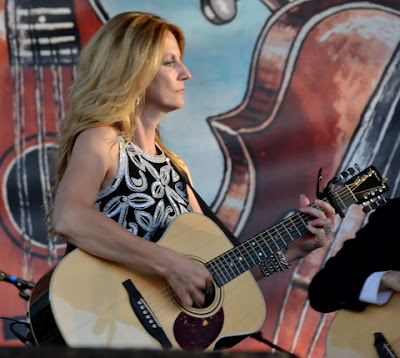

Clint White

Daniel Patrick

Dave Mullins

Lee Roy

Elaine Roy

Leigh Gibson and Super-Fan Phil Wells

John Saroyan and Kids (two are his)


Other Kids


Audie Blaylock & Redline

Audie Blaylock can always be counted on to deliver an all-out performance with enthusiasm and strength. His hard driving traditional bluegrass was right in the pocket for this tradition loving crowd which greeted Audie and his band with genuine enthusiasm. His band has a big sound with strong instrumentalists at every position. Patrick McAvinue on fiddle has become a mature, seasoned performer whose work continues to show nuance and tone. Russ Carson is one of finest young banjo players around. Austin Ward on bass is both unobtrusive and a standout performer. Audie Blaylock, deeply influenced by his time with Jimmy Martin is a fine singer and rhythm guitar player. They always deliver a satisfying show.
Audie Blaylock

Russell Carson

Patrick McAvinue

Austin Ward

The "Meet the Perfomers" Tent
The Gibson Brothers


Bluegrass Sirens
B.J. McGee, Candi Sawyer, Sherry Ravlin


Michelle Canning - Emceeing

Clayton Campbell & Joe Joe Saroyan
A Lesson from One of the Best

The Gibson Brothers


The Gibson Brothers arrived on stage for the closing set on Saturday night with Leigh wearing a talisman to ward off another attack of the moths. It mostly seemed to work, although there were a few around to add atmosphere. Relaxed and enjoying their welcome from old friends who come from all over New England, New York, and now the rest of the country to wherever the Gibsons perform, the brother duo delivered again. It was a pleasure to hear their newest addition chime in with a baritone harmony on one song without in any way diminishing the power and effectiveness of the brother harmonies so loved by their old and an increasingly sizable crowd of new fans. Sprinkling in a goodly number of songs from their currently #1 CD They Called it Music with fan favorites from years gone by, the brothers continued to cut a swath of pleasure. They Called it Music has achieved a never before accomplished feat of becoming the seventh consecutive album by a single group to reach the top. Candidates for IBMA nominations in several categories, Leigh Gibson deserves serious consideration for Male Vocalist of the Year.
Leigh Gibson

Eric Gibson

Mike Barber


Jesse Brock

Clayton Campbell

Eric Gibson

Leigh Gibson & Mike Barber

Irene Lehmann & Leigh Gibson

Fans


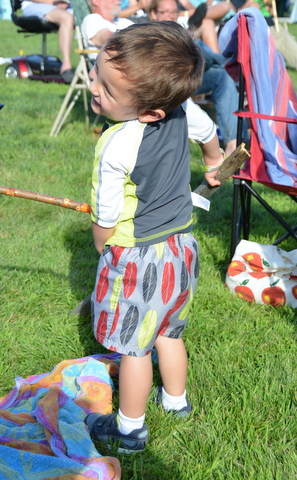
Smokey Greene Watching
the
Gibson Brothers

Etta, Aaron, Brian, George

Under the Shade Tent

Dancer on the Hill


Kim Vickery at Gibson Workshop

We had a wonderful day at Pemi Valley. The leadership at this festival is strong: experienced, far-seeing, and eager to learn more. The site is superb: simple, yet providing sufficient room for almost unlimited expansion. The sky appears to be the limit for this festival whose move to a new location promises nothing but opportunity. We think that opportunity has been given to people who can use it to its best advantage.
The End of an Evening


