Showing posts with label Baseball. Show all posts

Saturday, May 26, 2018

The Heritage by Howard Bryant - Book Review


The Heritage: Black Athletes, a Divided America, and the Politics of Patiotism by Howard Bryant (Beacon Press, 2018, 288 pages, $26.95/18.99) begins and ends with Colin Kaepernick, the black American football player who, when he’d had enough, decided to take a knee during the playing of the national anthem before kickoff of his now former team, the San Francisco 48ers in protest against the treatment of young black men at the hands of police across the country. Between these bookends lies a rich history of the political and social involvement of black athletes from the 1920’s to he present. Bryant writes highly readable prose, supported by anecdote and statistics to show the evolution and devolution of the super-stars during three distinct periods. The book is persuasive and interesting. Many people who read it will nod as the book rushes by and cheer at the conclusions. Lots of readers, less inclined to hear and understand, won’t like what they read.

After introducing the problem and model represented by Kaepernick, Bryant takes the reader back to the mid-twentieth century by introducing one of my own musical and political heroes, Paul Robeson, who, as a black student at Rutgers in the 1920’s twice recognized as a consensus All-American football football player and class valedictorian, graduated from Columbia Law School and established himself as an actor, singer (Old Man River and Water Boy), flirted with Communism before being deprived of his passport by the House Unamerican Activities Committee, and became a hero of the civil rights movement before his death in the 1965.

Bryant recognizes black athletes as creating a heritage of advancement and courage in the face of pre-war Jim Crow America and the world of increased opportunity represented by their return to an America changed by World War II and Harry Truman’s elimination of racial discrimination in the armed services. There athletes, represented by the likes of Jesse Owens, Jackie Robinson, Joe Lewis, Jim Brown, Kurt Flood, professor Harry Edwards, Muhammad Ali and others established the place of black athletes to play and to speak out. Many, like Kurt Flood, John Carlos, and Muhammed Ali all sacrificed years of their professional lives as the organized sport and public resistance shortened or ended their careers. Their sacrifices and successes served to pave the way for others.“We had to take care of each other,” former baseball player and manager Dusty Baker said. “There weren’t that many of us. You knew the game didn’t always want you. You had to pass on what you knew, like, prepare the ones that were coming. That was your responsibility.” While sports provided an entree to wealth and fame, black intelligence and thoughtfulness were denied or ignored.

The second era, characterized by Bryan as the period of “Shut up and play!” featured the emergence of superb athletes who were able to dominate their sport, but were, at the same time, willing and able to characterize themselves as virtually race-less. While obviously men of color, their demeanor and dominance of their sport occurred in a time where their salaries as players were dwarfed by their income from product endorsements and public appearances. Athletes like Michael Jordan, Tiger Woods, O,J. Simpson preferred to duck social issues, while living lavish lifestyles and not speaking out on social issues, despite the fact that many able and talented black athletes were not being rewarded in the ways that they the stars,were. Bryant argues, “that for all the money, the players were still black, and the minute any one of them ran afoul of the white mainstream public, either by decline in play or by specifically taking a political stand that advocated for African Americans, that same public would be quick to turn on him.”

Then, two commercial airliners were crashed into the twin towers of the World Trade Center on September 11, 2001 killing 2997 people and the world changed. Patriotism blossomed. The U.S. had eliminated compulsory military service in 1973, and all our armed services were staffed by volunteers. These two events ushered in a period of patriotic fervor eagerly promoted and paid for by professional sports. Policing that increasingly used military hardware and former members of the military to staff its force. Meanwhile, proliferating police illegal shootings and violence against the black community coincided with patriotic celebrations held in stadiums and on playing fields around the country. A new era of resistance to black issues came up against a new voice of African Americans with the money and the self-awareness to speak out on the issues confronting them as they became the majority of athletes in both the NFL and the NBA. Bryant characterizes this period as “The Awakening.” Black athletes’ voices were heard and their money was spent to help speak for them. LaBron James, Carmello Anthony, and, perhaps most visibly, Colin Kaepernick became symbols of the new willingness to speak out and contribute cash to causes. Bryant comments, “The real reclamation is when you decide to get on the bus. Where do you get on the bus? Where will you participate? The question will be, ‘What did you do for the people? What did you do with your wealth? Can I impact the life of a young person when it counts, not when it’s safe?”

Howard Bryant


Howard Bryant is a sports journalist and television personality appearing on both the radio and television. He often appears on the ESPN program The Sports Reporters as well as NPR’s Weekend Edtion. He has steadily risen from local beat to national prominence as a reporter and commentator. The Heritage is his fifth book.

Any white reader expecting The Heritage: Black Athletes, a Divided America, and the Politics of Patiotism by Howard Bryant (Beacon Press, 2018, 288 pages, $26.95/18.99) to provide comfort, should be warned. This book, read with an open and attentive mind will make you uncomfortable. Bryant’s narrative is compelling, his story-telling superb, his use of examples cogent and on-point, and the case he builds strong. The nexus of racism, changed definitions of patriotism, courage and avarice, and white complicity to silence the black athlete are difficult or impossible to deny. I highly recommend this book to any reader eager to understand the role of sport within today’s politics and divisions. I was provide the book as a pre-publication download by the publisher through Edelweiss. I read it on my Kindle app.

Please remember that titles I review are linked to Amazon.com and ordering through the links in the text or the  Amazon.com portal on my blog will result in a small commission to me. 

Saturday, May 24, 2014

A Nice Little Place on the North Side: Wrigley Field at 100 Years by George Will - Book Review


A Nice Little Place on the North Side:Wrigley Field at 100 Years by George Will (Random House, 2014, 226 pages, $26.00) celebrates the 100th anniversary of the opening of Wrigley Field, one of the last remaining old baseball parks, and the ongoing futility of the woebegone Chicago Cubs, a baseball team that hasn't won a World Series since 1908 and not appeared in it since 1945. Despite a storied early history and plenty of fine players who have graced Wrigley Field, this is an unparalleled record of futility, which is belied by the ability of Wrigley Park and the Cubs to bring customers through the gates to enjoy an afternoon, during years of day baseball long after lights were installed elsewhere. Will is most often noted as one of the deans of newspaper column writing, his conservative take graced by elegant writing and, often, close analysis. Beyond that, his passion for baseball in general and the Chicago Cubs in particular is unmatched. He is an elegant writer, filled with both facts and insights in both areas. A Nice Little Place on the North Side is an intriguing, yet maddening, work which presents a good read, although it does not reach the excellence of his previous baseball book, Men at Work. I haven't read his other baseball book, Bunts.

Wrigley Field

Will has a marvelous eye for detail, a penchant for history, and an ear for the unusual circumstance. He uses all three qualities to good effect in this book. Nevertheless, there's a maddeningly strange feel for the unusual coincidence that I found reminiscent of Bill Stern (1907 - 1971), one of my childhood's most treasured catalogers of the strange and unusual in sport. As Stern might have, and perhaps even did, Will tells who the Cubs player was that played in the last game in which Babe Ruth hit a home run and the first game in which Henry Aaron hit his first home run (Answer: Phil Cavaretta). Other pieces of interesting trivia are the intriguing relationships between Jack Ruby, Ray Kroc, and Ronald Reagan, with Wrigley Field. He also tells about the famed double play combination of Tinker to Evers to Chance, who weren't as good as the poem that tells their story and who wouldn't even talk to each other. If I remember correctly, Stern told this story, too. Will's writing is always elegant, cultivated and sometimes convoluted, as he explores the nooks and crannies of being a Cubs fan with insight and depth from the perspective of a fan as well as a Princeton Ph.D. who also attended Oxford University.

Hack Wilson

In many ways Will, like his alter ego the distinguished political columnist and social commentator, never veers very far away from his roots. He's at his best when he writes about history. He talks about the rise of Chicago as the engine of commerce and growth in the Midwest while pretty thoroughly trashing one of my once favorite poets, Carl Sandburg. He suggests that Wrigley Field itself might be the cause of the Cubs' incompetence through the years as he details the career of Phil Wrigley, son of the team's founder and long-time owner of the Cubs. Wrigley, who didn't much like baseball, saw Wrigley Field as a park in the midst of the city where people could come for a day in the sun in a park-like environment while a baseball game took place before them. He cared more for the fan experience than he did about building a winning ball club.

Ernie Banks


Will makes considerable hash out of two important elements central to the nature of baseball in America: race and beer. In his chapter on race in baseball, Will talks about the not charming history of race relations in Chicago, including the placement of Wrigley Field on the North Side, a largely white enclave. He points out that the largest crowd ever to fill Wrigley Field, at the time, came to see Jackie Robinson's first game there in 1947. He lavished praise on the black people who came to this event in their Sunday best and cheered with lusty restraint, the way he might want the good black people of Chicago to present themselves to a largely white audience. Finally, however, he ends up trashing Ernie Banks as a mediocre fielder who became Chicago's most beloved player, despite a career with a mostly loosing team. Somehow, Banks emerges more as a symbol of futility, almost an embarrassment, than the Hall of Fame member he is and deserves to be. Will's chapter on beer suggests that attendance at Wrigley Field is more responsive to the price of beer there than to the record of the team, supporting the allegation with extensive research, as he details some of the history of beer.

George F. Will - Baseball Fan


George F. Will is one of the most widely read writers in the world, with his twice-weekly syndicated column appearing in more than five hundred newspapers and online news sources. He is a Fox News contributor and the author of thirteen books, including Men at WorkWith a Happy Eye But . . .BuntsThe Woven Figure, and One Man’s America. A winner of the Pulitzer Prize for Commentary and the Bradley Prize for outstanding intellectual achievement, he lives in Chevy Chase, Maryland.

Will is at his best when he deals with pocket profiles of people like Hack Wilson, P.K. Wrigley, Ernie Banks, and minor players, Wrigley Field itself, the City of Chicago, and the Cubs. He is less convincing when his concerns within baseball overlap his political and social ideology, for instance in race. Nice Little Place on theNorth Side: Wrigley Field after 100 Years by George Will (Random House, 2014, 226, $25.00) turns out to be mostly a catalog of failure – bad players, quirky happenstance, bad management, lack of ambition, and just bad play. How all this became lovable remains a mystery. I recommend this book for sports lovers with at least a small taste for the literary in their sports reading. The book is extremely well-documented and filled with interesting narrative. Will, however, has a penchant for trenchant cuteness. For instance, he mentions that April is, indeed, the cruelest month, without mention of T.S. Eliot (the great American poet and Anglophile), expecting his readers immediately to recognize the reference. Despite lapses like this, the book is mostly a delight for literate baseball fans. The book was provided to me by the publisher as an electronic galley. I read it on my Kindle.

Sunday, May 11, 2014

Visit to Washington: WAMU, Baseball, Monuments & Museums


We checked into Cherry Hill RV Park on Monday afternoon after a pleasant drive from our stopping off place near Harrisonburg, VA. Cherry Hill, located in College Park, MD is not only the closest RV Park to Washington, D.C., it's the best urban park we've ever stayed at, well organized to provide all the services necessary for tourists visiting the nation's capital, including easy transportation to the nearby Metro system, which offers access to almost all sites downtown. At the desk, they provided us with a Senior Pass ($2.00) which we filled up at the kiosk on our first visit to the Metro and never again worried about the cost of transportation - convenient and easy.

Irene Heads into the Maw of the Metro

Our friend Katy Daley is the longtime drive-time host of WAMU's Bluegrass Country. WAMU, whose history goes back to before NPR was founded, is a service provided by American University. Bluegrass Country, as far as I know, is the only terrestrial radio station in the U.S. providing round the clock bluegrass music 24/7. It has been an integral voice in the development of bluegrass music in the Washington area, and now is streamed worldwide over the Internet. The station moved into new, spacious studios early this year, and we visited to get a sense of the facility as well as to see Katy at work. The facility is a state of the art building with lots of room provided for expansion of services. A radio station is a strange place, because what we hear when listening suggests more action than is actually seen in the station. Katy sits behind a large electronic desk with computer screens providing access to the entire recorded catalog of Bluegrass Country. She selects songs, introduces them, clicks a button, and they play. Between sets of songs she reads announcements of coming events, public service announcements, the weather and traffic. Her friendly voice is familiar to hundreds of thousands of people in the D.C. area, to a spreading regional radio audience via local transmitters on HD radio, and to a world-wide audience streamed by the Internet. Bluegrass Country hosts numerous live interviews and performances of bands coming through Washington, and has used its new, larger performance area to provide live streaming with video of band performances. Look for this activity to expand.

Katy Daley at Her Broadcast Console

Performance Area for Live Visits

Large, Flexible Studio for Shows with Audiences

Studio Engineer for Diane Rehm Show

Bustling Offices - Programming, Development & Much More

At 10:00 AM Katy signed off after four hours on the air, handing the show off, and we headed down to her car parked behind a heavy, metal garage door which opened at the press of a button, and headed out to see Washington through the eyes of a lifetime resident. While tour buses, open air London-style buses, and even an amphibious duck that takes people on land and water trips ran up and down the streets, we saw the city through the eyes and spirit of a person who loves her city and loves introducing it to friends in a personal and direct fashion. While we have visited the District before, we had never seen it in such a way.

The Marine Corps Memorial

The Marine Corps Memorial is a giant sculpture by Felix de Weldon made from the iconic photograph by Joe Rosenthal picturing the raising of the American flag over Mt. Suribachi on Iwo Jima on February 23, 1945. It stands in Arlington, VA commanding a wonderful view of the District. When we were there, two Marines were busily running flags up and down the flagpole for presentation to veterans. 


Katy Daley & Me in Front of the Marine Memorial

The United States Air Force Memorial

This stunning monument, designed by James Ingo Freed (who also designed the U.S. Holocaust Memorial) depicts the expanding contrails of the Air Force demonstration team, the Thunderbirds, as they head into the sky. Located near the Pentagon, it commands another iconic view of the District.

Washington Monument from Air Force Memorial

National Cathedral from Air Force Memorial

Bronze Honor Guard at Air Force Memorial

Arlington National Cemetery

I suspect that most people visit Arlington to watch the changing of the guard at the Tomb of the Unknown Soldier and to see the perpetual flame at the John F. Kennedy gravesite  as well as a few convenient sections of nearby graves. The overall impression is one of quiet rest after the ultimate sacrifice. A little known feature of graves at Arlington is that spouses of the dead may be buried in the same site as their spouse with their names placed on the reverse side of the stone. Another revelation to me is that the plain stones that dominate are not required, and that families can pay to have more elaborate or informative stones. 


Abner Doubleday - Credited with Inventing Baseball


Edmund Rice Medal of Honor Grave & Memorial


Lincoln Memorial from Arlington

Martin Luther King Memorial


I found this newly opened memorial to be particularly moving. The inscription on Dr. King's statue reads, "Out of the Mountain of Despair, A Stone of Hope." The symbolism of the three granite blocks is obvious. It was designed by the ROMA Design Group and opened 2010.

Jefferson Memorial from MLK Memorial

A Drive-By of the U.S. Capital Dome 

Katy Drops Us at the Metro


Back Into the Tunnel

Clean, Fast, Inexpensive

Home Base Metro Stop

The Nats - Dodgers Game - How the Other Half Lives

Katy Daley & Bill

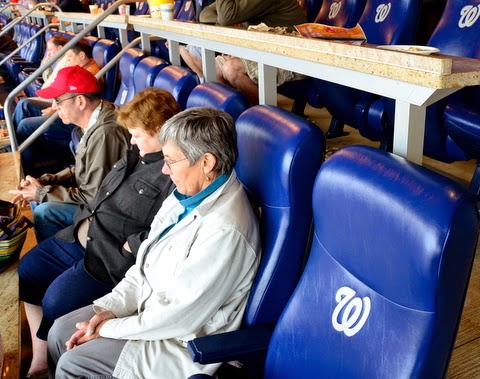
Dave, a friend of Katy's scored seats for us at National's Stadium. None of us expected them to be in Jefferson Suite 49.

Liberty Suite #49


Yee Haws Giddy with the Joy of Discovery

Two Hour Rain Delay

Irene, Bill & Katy

Concession Area 

Where "Everybody Else" Waits for Rain to Stop

Our Section

Great Game: Nats - 3, Dodgers - 2


The Presidents Race Around the Outfield


Abe Charges through for the Win!


Teddy Enjoys It All


Our Seats

Where Did These People Arrive From?

A Peek at Another Suite

After the game we were treated to more details as we drove to dinner, with appropriate commentary about the District history, including the lowdown on why there's no Metro in Georgetown. We went to nearby Bethesda, Maryland for dinner at the China Pavilion, one of the best Chinese restaurants we've had the pleasure of visiting. It's hard to imagine not getting a meal with something to everyone's taste there. 


The Return to Reality


On Friday we again boarded the Metro to do some sight seeing on our own, visiting museums along the Washington Mall between the Washington Monument and the Capitol. Along the way I saw a sign which summed the Smithsonian up pretty well. It read, "So many museums, so little time." How true!

Out of the Metro at the Smithsonian Stop

The Capitol

The Washington Monument

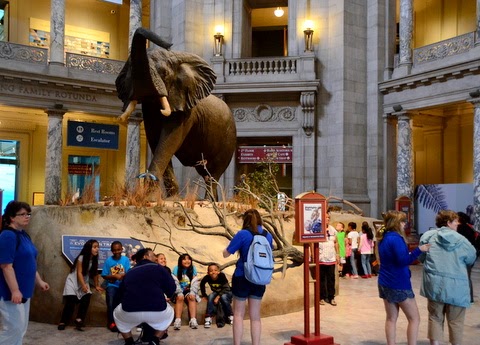
Smithsonian - National History Museum


The Original Smithsonian Institution

Smithsonian - American History Museum

We were told that if you were to read the information and view each of the exhibits at the Smithsonian, it would take 85 years. Of course, if you did that, by the time you finished everything else would be changed and you'd have to start over. We had only a day and the limits of our stamina, so most of the day included general impressions, except for our visit to the Holocaust Museum


A Travel Trailer from the 1930's


The United States Memorial Holocaust Museum

The Holocaust Museum, dedicated to exploring the horrors that Hitler and his Nazi regime visited upon the Jews of Europe with the subsequent loss of six million lives as well as the callous response of the rest of the world to their plight until after the war ended, requests that visitors not take pictures in the major part of the museum, so all the photos used here are ones I've taken from Google Images. As people enter this exhibit, they pick up a profile of an individual person, who they follow through the exhibits from Hitler's ascension to power in 1932 until the end of the war in 1945. What struck me most was how people's behavior and attitudes changed as they were led through the exhibits. They became quiet, and then a spirit of almost worshipful silence developed as the horror of the holocaust took charge. I had studiously avoided this experience, but found myself glad I had finally faced and embraced it. Visiting this museum is, indeed, a powerful experience.

The Holocaust Museum

The Hall of Remembrance


We're leaving Washington this Mother's Day for the Gettysburg Bluegrass Festival, but Gettysburg itself seems a fitting place to be next week. Do plan on visiting the Holocaust Museum, though. And our deep thanks to Katy Daley and Bill.