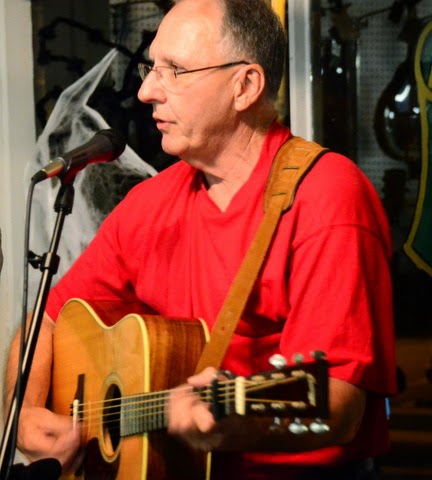
Showing posts with label Dr. Tom Bibey. Show all posts

Monday, February 16, 2015

Snapshots by Darin & Brooke Aldridge: CD Review


Snapshots is the sixth album Darin & Brooke Aldridge have released, a collection of songs highlighting “bits and pieces of our past. Snapshots includes songs that showcase bands we've always admired or been a part of, songs we've always loved or written, songs we grew up hearing on the radio, and songs folks have passed along to us that have helped them through difficult times in their lives.” The recording includes songs of commitment, faith, and hope, just the sort of material this duo has highlighted throught their career.

Most of the band on Snapshots is composed of Becky Buller-Haley on fiddle, Tyler Collins on banjo, Collin Willis on Dobro, and Dwayne Anderson on bass. Included are guest appearances by Sam Bush, Ricky Skaggs, Bobby Hicks, and Steve McMurry. As usual, Darin Aldridge doubles on mandolin and guitar thanks to the wonders of modern recording. Brooke's wonderful voice dominates the recording. Known for her vocal power, Brooke's sublety and thoughtful interpretations are always a consistent component of her singing. Songs spanning a period from the late nineteenth century to fresh out of the box show the range of material the duo uses and their keen ability to make each piece their own.

Darin Aldridge


The album opens with an upbeat gospel song written by Marty Stuart and Jerry Sullivan and featuring Sam Bush on mandolin and harmony vocal called Get Up John. This is a lively, driving song urging John the Baptist to haul himself out of bed and get to his appointed responsibility of meeting Jesus at the River Jordan to annoint him for his ministry. Brooke Aldridge's clear, powerful voice awakens the listener on this opening track as it's intendend to get the Baptist going, too. The song stands as a powerful demand for John as well as an attention getter on this album.

Bill Monroe's Rose of Old Kentucky takes more than an obligatory nod to the father of bluegrass music in a thoughtful twining of Darrin and Brooke's voices around Bobby Hicks' guest fiddle and Darin's mandolin. This song, reportably one of Bill's “true story” songs, along with Sweet Georgia Rose was first recorded in the famous Columbia Records recording session in 1947 and 1948 with Flatt & Scruggs in the band, which helped catapult Bill Monroe & the Bluegrass Boys to stardom. Because it combines the historical provenance with Darin & Brooke's commitment to wholesome love songs, it functions on a number of important levels in this album.

Gillian Welch's Annabelle features the members of the Darin & Brooke Aldridge touring band. I'm a fan of hearing the band I see at festivals on the CD's the band produces. While I know that guest artists add to the glamour and allure of a recording, we buy CD's not only to support the band, but to try to re-create the experience we had seeing them at festivals we attend. With a plaintive opening instrumental sequence provided by Colin Willis on the Dobro, Tyler Collins on banjo, and Becky Buller-Hayley on fiddle, the song asks how we can understand the difficulties of life “until we've all gone to Jesus, we can only wonder why” as the character in the song contemplates the difficulties and hardships that life and death in the mines or the fields present. The arrangement exudes both mystery and hope in the plaintive blending of Darin and Brooke's singing with the music.

Brooke Aldridge


Lets is an aspirational love song about doing the things in life that bring pleasure while demonstrating the bond of a couple. Written by Eddie Adcock, the song is filled with lovely images of high mountains, beautiful vistas, and strong togetherness. The driving banjo is no surprise here, considering the writer. Tyler Collins has his own style that works better than fine here. Becky Buller, in her last recorded appearance on a Darin & Brooke album, plays fiddle on all the cuts which have a fiddle. She has since left the band to form her own. People seeing the Darin & Brooke on the road and in future recording will enjoy watching, and hearing, the contributions of the young, but quite accomplished, Carli Arrowood, who has joined them.

When He Calls is a gospel song with a guest appearance by Ricky Skaggs written by Paul Kennerly. Skaggs' voice blends into a beautiful trio with Darin & Brooke's strong and fervent duet singing.

Tennessee Flat Top Box captures the flexibility of Brooke's voice in a bluegrass interpretation of Johnny Cash's popular country song. It will prove to be popular in the way her earlier I want to be a Cowboy's Sweetheart has. She can consistently deliver a song with strength and conviction. Darrin's presentation of the guitar solos captures the spirit of the original. Jim Solde played the solos on the video I watched, Darin got it just right. It takes courage to cover Cash this way, and Brooke and Darin pull it off.

Let it Be Me (Becaud, Curtis, Delanoe) was first recorded in French in 1955 and later became a world-wide hit by the Everly Brothers, whose most popular recording was released in 1960. This is a classic love song interpreted by this duo which has specialized in heartfelt love songs. Darin & Brooke have brought the song up-to-date with some interesting vocal moves that take the sappiness out of the original. Darin's opening mandolin solo sets the tone and later returns with subtle, warm figures. This rendition shows the qualities that change a cover into a serious reinterpretation of a wonderful song.

The next song, He's a Coming (Whyte, Shaffer, Smith) strikes a welcome and sharp contrast to the previous one, as a peppy, upbeat gospel song with Becky Buller adding her vocal spark in a harmony. Brooke shows her vocal versatility by contrasting her voice against the darker, more sultry voice found in the previous song. Matt Love revisits his former band-mates on banjo in this cut.

Written by Steve McMurry, a former bandmate of Darin's with “Acoustic Syndicate,” A Better Place is a long song about the search for faith and self through seeking to reconnect with one's roots and the welfare of a loved one. Strong instrumental work.

Darin with, his lifetime friend Dr. Bobby Jones, a phsysician from Shelby, NC who wrote a terrific blog examining the life of a small town doctor who was also a musician and a golfer under the pseudonym of Dr. Tom Bibey as well as a novel The Mandolin Case before his sad death in 2012, wrote this lilting gospel song. The song stands on its own, but is also a tribute to a key anchor in Darin's life.

Snapshots concludes with a classic Darin & Brooke duet called Wait 'Til the Clouds Role By attributed here to Uncle Dave Macon, but with a much older history referred to in a broadside published in Scotland dating it back to 1880 or so and copyrighted by T.B. Harms. The song, sung as a duet accompanied by Darin on the guitar, is a lovely pledge of enduring commitment, a fitting way to end an album that is arguably the best work Darin & Brooke Aldridge have done since their debut recording.

Darin & Brooke Aldridge

Friday, October 17, 2014

Some Music in Shelby


After the rigors of IBMA week in Raleigh, we needed some rest, some quiet time to be with friends, write, and recuperate with long naps and good visits. Our Lake Cottage on the shores of John H. Moss Lake between King's Mountain and Shelby, NC has filled the bill for us ever since we first went there to visit Dr. Tom Bibey (Dr. Bobby Jones). While Bobby is no longer alive, we've met and come to deeply care for a group of people who live, work, and make music there. It's an important restorative place for us to be.

Lake Cottage in Shelby


Beyond burnishing friendships and quiet time to recover, two events of the week stand out. Bluegrass music is alive and well because it takes place in quiet, out-of-the-way places where pickers can congregate and enjoy being together. Over the years we've covered quite a few of these performance and jamming locations, some easy to find, others hidden away where only a few know about them or can find them. Here's one of each:

Tuesday with Darin Aldridge & Friends


Angel's Restaurant (101 E. Virginia Ave., Bessemer City, NC) serves a number of purposes in downtown Bessemer City, a once thriving, mostly industrial suburb of Charlotte with a history dating back to an eighteenth century iron smelting operation. At present it is home to several large industrial corporations. The main street is neat and tidy with plenty of room for evenings at Angel's, where Darin Aldridge & Friends play bluegrass to an appreciative audience on Tuesday evenings. The  menu includes a variety of tasty sanwiches, hot coffee, sweet tea, and local wines, prominently on display. A corner of Angel's is devoted to a small shop selling guitars and such, while the back contains a consignment shop with a variety of wares. Angel's has a warm, somewhat quirky environment, perfect for bluegrass, a tasty lunch, or quick sandwich. Around 7:00 PM on Tuesday you can find Darin Aldridge along with a group of friends he has been playing bluegrass with since he was a teenager. They play familiar old bluegrass tunes, some newer ones, and invite members of the audience to join them on stage to pick or sing a song. We went twice during our stay, enjoying each evening with the music and our local friends. 

Angel's Front


Nice Place to Visit, Eat, Listen


(LtoR) Roger Holland, Carli Arrowood, Darin Aldridge,
Mike Lynch, Jeremy Arrowood (no relation)

Darin Aldridge

Mike Lynch

Carli Arrowood

Harold & Sharon Bess, Debbie James

Jack Bingham's Wednesday Jams

In the past I've written about the Bomb Shelter, built in 1959 and 1960, a time of great nuclear fear and the Cuban missile crisis, by Judy Bingham's father, which has become a local jammers hangout and a place where several young bands got their start under the tutelage of Darin Aldridge and earlier Dr, Tom Bibey (If you're not familiar with Tom Bibey, a local doc Dr, Bobby Jones writing almost fiction under a pen name, you can still find and explore his blog here. It's especially interesting to read in the years before a malignant brain tumor short circuited a fine literary career he had scheduled to supplant his medical practice in the near future. His warm hearted and interesting writing explores the life of a small town doctor who loves to play both bluegrass music and golf.) You can see a few pictures of the Bomb Shelter here, but very few, as its location is pretty well guarded by those who enjoy it so much.

Jack's Cabin

Jack's Cabin, which he has built over the past four decades and continues to improve, stands as a shrine to both his love of bluegrass music and traditional arts. The cabin, built a short walk from the Bomb Shelter, sits on a piece of property where Judy Bingham was raised. Judy forms a small triangle with her fingers to explain that she's lived in only three places for her whole life: her parents' home, an apartment on their property, and the house she and Jack now inhabit. It seems a small space, until you discover the rich musical heritage that visited there and made music. 


Vintage Instruments


 Brook & Darin Aldridge with Judy Bingham

Jack Bingham with a Turtle Shell Turkey Caller He Made

...and One Made from a Turkey Wing

Various Turkey Callers

Collection of Vintage Picks and Pictures

Bricks from Local Kilns

The collection covers a large range of Jack Bingham's interests and enthusiasms. He's carefully collected local musical artifacts and lovingly built and preserved elements of local culture. His commitment to a combination of preservation and celebration is really quite remarkable, as is the man who has devoted so much time and energy to creating this fine collection. Although Jack has passed the age of 70, he's still building and refining his piece of Americana.

The Cabin Exterior

Around the Blazing Campfire

Judy Bingham, Brooke Aldridge & Irene


The Jam

On a small outdoor stage, local jammers get together every Wednesday at the Cabin during warm weather and inside the Bomb Shelter during the chillier months.

Dereck Wolford


Brooke Joins the Jam for a Song


As is usual when we attend jams, we got home a little past our bedtime, but filled with the warmth and fellowship that spending time with Darin & Brooke as well as the Binghams always creates. We'll be back. Maybe next time I'll have courage enough to get my guitar out.

Monday, April 21, 2014

The Earl Scruggs Center in Shelby, NC - Our Visit


We first came to Shelby, NC in the fall of 2009 to visit a friend we had made on the Internet. We first knew him as Dr. Tom Bibey, who wrote a wonderful blog about being a small town doctor, a bluegrass musician, and a writer. It was warm, funny, and, to us, a deep mystery, because we soon realized that Tom Bibey was not the author's name. After several months of dancing around each other, the author revealed himself to us as Dr. Bobby Jones, indeed a family physician, musician, golfer, and writer who lived and worked in the small town of Shelby, and had played for many years in a band with Horace Scruggs, Earl Scruggs' brother. We met Dr. Bobby, as he was known throughout his bluegrass world, at a small, indoor festival run by Lorraine Jordan in Burlington, NC, and scheduled ourselves to come to Shelby for a visit later in the Fall. While there, he took us to the Bomb Shelter, a regional jam session, where we met Darin Aldridge, and a lot of his other bluegrass friends. He also took us to see the grave of country singer Don Gibson, and to the tiny nearby community of Flint Hill, where we visited the run-down Earl Scruggs' childhood homestead.

Scruggs Homestead in Flint Hill

He told us about a plan, then under way, to redevelop the long-closed Shelby County Courthouse, in the center of "uptown" Shelby as a museum dedicated to the life and work of the man who changed country music and redefined the banjo when he joined Bill Monroe's band in 1945. This winter, in a huge gala attended by music luminaries, the Earl Scruggs Center opened in Shelby, NC on January 11, 2014 to great acclaim. We were able to visit there in late March.

The Earl Scruggs Center

Cleveland County Court House


Scruggs Center Welcome Center

Main Desk at Welcome Center

Irene & Marta Jones
Shopping at the Well-Stocked Gift Shop

After several years of fund raising and under the auspices of Destination Cleveland County and with the full cooperation of the Scruggs family, those remaining in the region and Earl's sons in Nashville, the Earl Scruggs Center opened with visitors from Nashville including Randy and Gary Scruggs, Vince Gill, Sam Bush, Travis Tritt, Rob Ickes, Jim Mills as well as Governor Pat McCrory and Congressman Patrick McHenry. Darin and Brooke Aldridge, local bluegrass band and Nashville stars, performed at the opening ceremonies.


Flash Mob Performing "Reuben's Train"
at
United Methodist Church in Shelby


The Scruggs Center has successfully striven to place the life and times of Earl Scruggs within the context of southern culture in general and Cleveland County in particular. Located on the southwestern edge of the once rich Piedmont region, which prospered under a combination of growing cotton to supply a vast structure of textile mills, attracted away from New England in the late nineteenth and early twentieth century by the low labor costs and absence of labor unions. The region also had a rich and varied musical climate, celebrated by the Center. Earl Scruggs was born on January 6, 1924. The family was musically oriented, and Earl grew up in a musical environment, discovering a sophisticated three finger style of picking the banjo that was influenced by ealier claw hammer, two finger and three finger pickers. Scruggs' style, however, achieved musical prominence when he and Lester Flatt joined Bill Monroe's Bluegrass Boys in 1945. The Scruggs Center, through its interactive exhibits, films, and displays looks at Scruggs in whole, rather than through the lens of the few brief years he worked with Bill Monroe or the longer period of success with Lester Flatt. Earl Scruggs and his technique are seen as developing within the social, economic, and racial environment of the deep South in the mid-twentieth century. For Earl Scruggs, leaving work in a textile mill to become a professional performer was a natural step. No one could have predicted the profound influence his banjo picking would have on country and bluegrass music through the next fifty or more years.


Introductory Film

Young Earl


Typical of the high technology and thoughtful presentation characterizing the Scruggs Center are the innovative electronic table which has six stations permitting visitors to explore the place, genre, artist, influence, and instrument into relationship with each other. By tapping the intersection of two crossed strings, many elements come together to create bluegrass music can be explored. This magnificent table alone can take up hours of a visitors time, as the strings are played, and you can even jam together.

Museum Director Emily Eppley Shows Marta and Irene
the Musical Table


In another interactive exhibit, three styles of banjo playing (clawhammer, two finger, and three finger) are demonstrated through a window from below, clearly showing the hand actions required. By twisting the dials, one can slow down the hand action, getting a clear idea of the motions required by each style. (As a sidelight, this would be a magnificent technique to use to teach the banjo roles to a beginner.) Cleveland County Community College professor Al Dunkleman and instrumental great Darin Aldridge demonstrate the two styles.
Al Dunkleman & Darin Aldridge 
Demonstrate Picking Styles

Many bluegrass adherents prefer to picture Earl Scruggs' adventuresome approach and spirit as reaching its ultimate with his work in bluegrass music, downplaying his questing spirit which took him on the road for a number of years playing a variety of musical styles including folk and rock and roll with his family and friends for many years as the Earl Scruggs Review. For a period of time, this band was the second most popular college campus band in the country. Films show the Earl Scruggs Review in performance, as well as contemporary banjo greats like Bela Fleck and Chris Pandolfi attesting to Earl's influence in changing the way the banjo was perceived and played as well as attesting to his questing musical spirit.

The Earl Scruggs Center places Earl and his great work in the context of the culture and economy of his time in a small southern city just a few miles north of the South Carolina border. Earl grew up during the hard times of the depression, when music made in the family, church, and neighborhood was one of the few escapes from the drudgery of the cotton field and the mill. By the time Earl was a young teenager, he was recognized for the distinctive style and syncopation he had developed on the banjo, while working in a nearby textile mill, before escaping to reach for his musical destiny, still in his early twenties. 


The Cotton Industry

Farming

Contributions of African Americans to the 
Sourthern Musical Tradition


Social Change Throughout the Region

   The Scruggs's Turn Toward Rock Music

Local Voices Heard From


 The Late Dr. Bobby Jones (Dr. Tom Bibey)


Darin Aldridge, Irene, Marta Jones, Me


In addition to coming to Shelby to soak up the museum, be sure to set aside some time to explore the town square built around the old Courthouse. A selection of quality restaurants and shops have been renewed around the square to go with the magnificent work done to restore and repurpose the Court House. Also, take a trip to Shelby City Park to visit the wonderful restored carousel there.

Carousel in Shelby City Park

Information about hours and admission to the Earl Scruggs Center can be found HERE. Make sure you take the opportunity to capture this fine museum to increase your appreciation of Earl Scruggs the man and the musician.

How to Get to the Earl Scruggs Center
enter your current location in the zero to see a 
customized map


Earl Scruggs