The Raleigh Convention Center (RCC)
Sir Walter Raleigh's Necklace of Banjos
The Street Fair
The Red Hat Amphitheater
Raleigh has proven itself to be ready, willing, and able to provide a home for IBMA's World of Bluegrass by assisting the organization, it's members, those who already participate in this wonderfully varied music, and the potential audience for it to imagine itself in a new, varied, and creative setting which truly invites all to participate in acts of discovery. By taking the annual meeting of an industry trade association which, at its core, functions as a coordinating organization for the business of making bluegrass music and turning it into a celebration that opens its arms to all who want to become a part of this musical corner of the world, Raleigh has at once opened new paths and strengthened old ones. Despite the divisive, and for many quite confusing, issues surrounding gender politics, Raleigh as a city, exemplified by its mayor Jane McFarland, and its very active tourism and convention bureau have helped revive and strengthen the organization. The
World of Bluegrass and
Wide Open Bluegrass will take place in Raleigh from September 27 - October 1, 2016. This blog entry is designed to help attendees to make the most out of their visit, no matter what musical or professional goals they wish to accomplish during the week.
Overview
The week of IBMA's World of Bluegrass (WOB) is actually three separate events, each of which offers an abundance of music, social interaction, business opportunities, and more fun than most people can absorb in five short days. Thus IBMA (The International Bluegrass Music Association) becomes IBMA (I've Been Mostly Awake) composed of the Business Conference, The Awards Show, and Wide Open Bluegrass (also WOB) a huge ticketed and free event sponsored by the City of Raleigh and PNC which has attracted as many as 180,000 people to experience bluegrass in new and exciting ways. Both IBMA and Raleigh cooperate on the week, with major responsibility for Wide Open Bluegrass going to Raleigh while a major portion of the proceeds from ticket sales for the show at the Red Hat Amphitheater go to support the
Bluegrass Trust Fund, a non-profit corporation providing financial assistance to needy bluegrassers.
Apps: IBMA and Pine Cone have each produced apps. At this writing, much of the World of Bluegrass App is live and available online, although the smart phone download still has not been released. You can access it on your computer now, but an app will soon be available. (Keep watching here for its release) However, you can start studying the schedule and planning on sessions and events you wish to attend. I can't tell if the feature for putting events on your personal calendar has gone live yet, but, when it does, it's a valuable tool for using your time most effectively. Here's a link to the
IBMA World of Bluegrass 2016 app. As it becomes more functional, come back and visit. As soon as you can put it on your phone, you can start building a useful personal schedule. The schedule is complex. Time spent becoming familiar with it is time well spent. Similarly, Raleigh, its Local Organizing Committee, and PineCone, a regional arts organization, have produced an app to show you all the options available during
Wide Open Bluegrass. I'm told this, too, will soon be rolled out and available to all those wishing to use it. There is free Wi-Fi in the Raleigh Convention Center and along Fayetteville Street.
Maps: The downtown region where all the activities of World of Bluegrass take place encompasses only a few blocks with two hotels (
The Marriot and the
Sheraton) at their center, The Raleigh Convention Center lies directly behind the s and the Red Hat Amphitheater behind the RCC. The Duke Energy Center, where the Awards Show takes place stands across a small park. Fayettville Street, extending from the Duke Energy Center five blocks to the State Capital provides a home for Friday and Saturday's Street Fair. An area around Moore Park, just a few blocks away is the home to most of the venues for the
Bluegrass Ramble, where showcase bands (and others) perform during the week.
Map of The Convention Center Region:
Raleigh Visitors Center - The Greater Raleigh Convention & Visitors Center is just a phone call away for finding help in arranging accommodations and getting information about what Raleigh has to offer. It has a comprehensive web site, which can be very helpful. Beyond that, the
Visitor's Center desk at the side entrance of the Marriott Hotel is constantly staffed with helpful, knowledgeable people as well as providing brochures, maps, and help in negotiating your way around the area and the city.
The R Bus: The City of Raleigh provides a free circumferential bus (called the
R Bus) around the entire downtown area of the city. During World of Bluegrass it offers a special bus, called the Bluegrass Express, from in front of the Raleigh Convention Center (RCC) to all the venues associated with the Bluegrass Ramble. The larger trip, if you have time for a ride, will provide an overview of downtown Raleigh. The Bluegrass Express will allow you to sit down for a few minutes as it takes you to sites on the Bluegrass Ramble.
Walking: If you like to walk, you can use the gps on your phone to take you to any venue on schedule in just a few minutes. Google Maps offers your best choices for navigating from place to place, whether it's over short or longer distances. It offers driving, biking, walking & public transportation alternatives.
Raleigh Convention Center to Vintage Church
by foot on Google Maps
The Miracle of Raleigh 2015: In 2015, after two years of fine weather during IBMA week in Raleigh, the city was threatened by torrential rains resulting from the remains of hurricane Joaquin, which hit the Outer Banks. We had previously seen the cavernous basement space that would serve as the alternative to the Red Hat Amphitheater. With only forty-eight hours to move the entire seating pattern for 5,000 seats indoors, the task was accomplished on time. Meanwhile the vendors were able to fill the aisles with their wares, bringing crafts, indoors. A spacious food court was established. Bands scheduled for the Street Fair were assigned to rooms, all of which were filled for each performance. But the 180,000 people who filled the street in the previous year could not be accommodated. The building's capacity of 35,000, though, was probably reached or exceeded. Attendees wishing to attend the ticked or the free events will be able to enjoy their week, regardless of the weather.
The Dance Tent
Forlorn, Wet Street
At the Workshop Stage
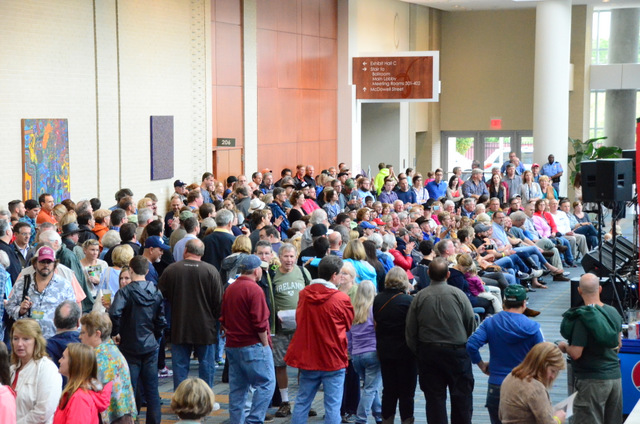
The Raleigh Convention Center Lobby
The Indoor Red Hat
Filled....
The environment was filled with anxiety, while IBMA, PineCone, and the RCC staffs put in two round-the-clock days to pull off the miracle of Raleigh. When the doors opened on Friday at noon, Wide open Bluegrass was ready to continue. Now let's return to 2016 and the Business Conference.
Business Conference
Business Conference: While other elements of the World of Bluegrass get more ink (I guess it's time for me to write about getting pixels. Does anyone even know what ink is today?), the
IBMA Business Conference is, for many, what this trade show is about. Others may come for the picking, to listen to music, to meet and greet people they haven't seen since last year, or to jam the days and nights away, but the Business Conference offers the opportunity, first of all, to learn about your business, to develop new skills, and to extend your web of influence to create more business for yourself as a part of a difficult, ever-changing, challenging enterprise. The Business Conference takes place from September 27 - 29.
Don't Miss Events During the Business Conference:
Conference seminars and meetings: During the Business Conference, which runs from Tuesday through Thursday, numerous seminars focused on specific learning and events centered in the RCC designed to encourage making and deepening professional relationships take place. Here's a
schedule of the events of the business conference.
Registration for the Business Conference includes all associated meals and admission to all showcases on the Bluegrass Ramble.
The Gig Fair Scene
Gig Fair for Artists - The Gig Fair, this year moved to Tuesday afternoon and requiring online pre- registration, offers artists the chance to make direct contact with a large number of festivals, concert venues, and other events. This event, which can only be described as "bluegrass speed-dating" gives bands an opportunity to establish face-to-face contacts with those who can and will be hiring them. Since each round is limited to ten minutes, bands must come prepared with a CD, a short, direct, well-designed folder describing themselves, and some good questions for the interviewer. They also need to
follow up by email, letter, and phone calls with each contact they make at the Gig Fair. Conscientious bands can schedule later meetings, make festivals aware of showcases where they'll be performing, and prime their potential employers. Without good follow-up, their efforts may be wasted. You can sign up and
learn more here.
An Artist's Interview with Boston's Joe Val Festival
Networking in the Bluegrass Expo: The IBMA Exhibit Hall is open during the day from Wednesday through Saturday, which includes free admission to the public during Wide Open Bluegrass. Dozens of exhibitors including instrument makers, equipment manufacturers, book publishers, bluegrass related organizations, festivals, and the thirty showcase bands selected for the Convention have booths. It's also a center of social interaction during which you can chat with people in the aisles or staffing the exhibits, again connecting a face with a name. (That's why the convention badge hung around your neck is so important.)
The Exhibit Hall
Official Showcases: Each year
thirty showcase bands are selected by a committee as Official Showcase Bands. They are guaranteed at least three performances, one of which
must be in the RCC. Further showcases are held in the five remote locations, all conveniently located a few blocks from the RCC and accessible by using the R bus or taking a short walk. Discussions always take place about whether the Ramble locations or the RCC showcases are a better place to view a band. There's no consensus as to whether seeing bands with a real fan audience or with a group of buyers and industry professionals is preferable, so both opportunities are offered. Bands are selected from applications and include new bands or better known, older bands which have made significant changes. Conference registration includes access to all
Ramble venues.
RCC Showcase
Club Showcase
Banquet Showcase
Bluegrass Ramble is
the catchall name for the showcases taking place around the venues. Those who wish to attend only the performances, can buy a
Ramble Ticket or even purchase admission to individual remote locations at the door.
Private Showcases are events sponsored by recording companies, certain large festivals, and others which feature bands often part of the company's stable of artists or being previewed for possible hiring at next year's festival. Some of these events are publicly scheduled, while others are held in a more private (and exclusive) setting. Keep your program schedule and your ears open for these events, scheduled throughout the entire World of Bluegrass week.
Awards Shows
While the annual awards show at which the IBMA Awards presentations are made and featuring major performances by current and recent bands highlighted, there are actually a series of awards presented at a luncheon on Thursday during the Business Conferences which often carry more interest for bluegrass industry people. The Momentum Awards, also presented at a luncheon on Wednesday, highlight up-and-coming artists, recognize individuals who have mentored new artists, highlight people for their involvement inside the bluegrass industry, and site important new venues. The Special Awards Luncheon, held on Thursday, focuses on such specialties as Bluegrass song-writer, event of the year, Print/Media person, liner notes and album design, radio personality, and others. At this banquet, five people are recognized each year as recipients of the
Distinguished Achievement Award. This award, the most coveted IBMA has to offer short of induction in the Hall of Fame, often evokes emotional, heartwarming responses as people who have made major contributions to bluegrass during a period of many years receive recognition.
Murphy Henry Receieves 2015 Distinguished Achievement Award
The IBMA Awards Show
The Duke Energy Center
The Awards Show is IBMA's signature event, the major dress-up, get recognized, be seen event of the IBMA calendar. Members of IBMA have been involved in a three step nomination and voting process since June, the nominees were announced in August, and the final results, as well as a handsome trophy are awarded here, in a carefully produced event that strives to showcase bluegrass music to the world's music consuming public. The show is broadcast live on Sirius/XM radio and recorded for wider distribution on television.
Tickets can be purchased here.
Some 2015 Highlights
The Gibson Brothers Host the Show
Multi-Award Winner: The Earls of Leicester
The Earls of Leicester Receive One Several Awards
Bill Keith is Inducted into the Hall of Fame
Wide Open Bluegrass
Wide Open Bluegrass held on Friday and Saturday (September 30 and October 1) is the largest urban bluegrass festival in the world. It has replaced the former IBMA Fan Fest as a celebration of bluegrass music and the major fund raiser for the
Bluegrass Trust Fund, which offers
"financial assistance to bluegrass music professionals in time of emergency need." Composed, broadly of two major events, Wide Open Bluegrass sponsors a ticketed show featuring many of bluegrass music's most storied and popular bluegrass performers in a concert setting plus some of the greatest stars in jams in the Red Hat Amphitheater, a 5,000 seat outdoor venue. Meanwhile, the free StreetFest has attracted as many as 180,000 people to two days of music on six free outdoor stages, craft and food vendors lining Fayetteville Street from the Plaza Stage, across the street from the Sheraton Hotel, down to the State Capital.
Plaza Stage
Fayetteville Street
Meanwhile, the Raleigh Convention Center will be open featuring the Expo Hall, which will have been re-purposed for a consumer oriented outreach, seminars,
Pete Wernick conducting a free mini jam class in the Main Lobby in which people will get a chance to learn and play together, a film festival, and more. Once again the
North Carolina Whole Hog barbecue contest will take place in a parking lot between the Marriot and the Duke Energy Center. The resulting pulled pork will be sold by the
Interfaith Food Shuttle in a booth on Fayetteville Street with the proceeds going to local food pantries.
StreetFest Map
The StreetFest is a bee-hive of activity from one end of Fayetteville Street to the other. At the Plaza Stage crowds of several thousand gather to see headliner bluegrass bands perform as well as the IBMA Kids on Bluegrass, who have been working together for several days to prepare a major presentation for Saturday afternoon. Side stages on the cross streets host sound stages where major local and regional bands perform. For people planning on staying to listen to performances, I'd recommend carrying a light, highly portable bag chair. We like the three legged ones.
Good for Mobile Festival Watching
Al Batten & the Bluegrass Reunion
on a Side Street Stage
Russell Moore & IIIrd Tyme Out
Jamming with Kids on Blugrass
Audience at the Plaza Stage
Frank Solivan & Dirty Kitchen - Plaza Stage
At the Dance Stage
Craft Vendor on Fayetteville Street
...For Kids
Red Hat Amphitheater
The Red Hat Amphitheater is the outdoor site of the major ticketed event of Wide Open Bluegrass. The
schedule for the Red Hat offers perhaps the best lineup of bands you can see at any bluegrass festival in the country this year, or any other that I can think of. You can buy
Amphitheater Tickets Here. It would be easy to sit here, in the sun through most of the afternoon, all day from 11:00 AM until 11:00 PM, except...there's so much else to see and do.
The Red Hat Stage
...And Audience
Audience with RCC in the Background

As of this writing on September 6, 2016, the complete schedule of Wide Open Bluegrass has not been published. When they become available, both IBMA for the Business Conference and Raleigh/Pine Cone/PNC will be posting a more detailed schedule available on smart phone apps and online. As soon as I know this has happened, I'll post them here with pointers on my FB pages, the IBMA email lists, and various instrument hangouts. Meanwhile, the entire Business Conference schedule is available for you to study, although you may not be able to add events to your personal calendar yet.
Here's the link. Remember, the more time you spend
Now familiarizing yourself with the schedule and planning your activities, the more valuable this event can be for you. The best advice I can give to those wishing to increase their visibility in bluegrass is to diminish the time you spend jamming (Yes! I know how important that is to you at 1:00 AM when your juices are flowing, but will you be able to get to the 10:00 AM seminar that may contain advice crucial to your bettering your chances of working more, and more effectively at your job in bluegrass?)
I'll be posting brief live-blogs from the various venues here as well as to my Facebook page and Instagram, if I can keep it up, during the entire week, beginning with the pre-festival activities taking place around town. Tune in to follow the action. I'll also schedule blog entries during the following weeks to wrap up and review each component of the week.
IBMA's
World of Bluegrass and
Wide Open Bluegrass is an all-absorbing effort, filled with hard work, great fun, and any number of surprises. Get involved. join the organization, learn more about bluegrass, and plan to be there. Please stop me to say "Hello" if you catch me.